

The windows in your dining room do far more than let in light — they frame your world, set the mood for every meal, and serve as a defining architectural feature that shapes the entire room’s character. Whether you gather for quick weekday breakfasts or linger over weekend dinner parties, thoughtful window design profoundly influences how the space feels and functions every day.
From dramatic floor-to-ceiling sheers to charming café curtains, bold black frames to motorized smart shades, the possibilities for dining room windows are as diverse as the homeowners who choose them. Here are 20 stunning dining room window ideas spanning traditional, modern, farmhouse, Mediterranean, Victorian, and contemporary styles — each with practical guidance to help you maximize natural light and beauty.
1. Sheer White Curtains for Elegant Light Filtering
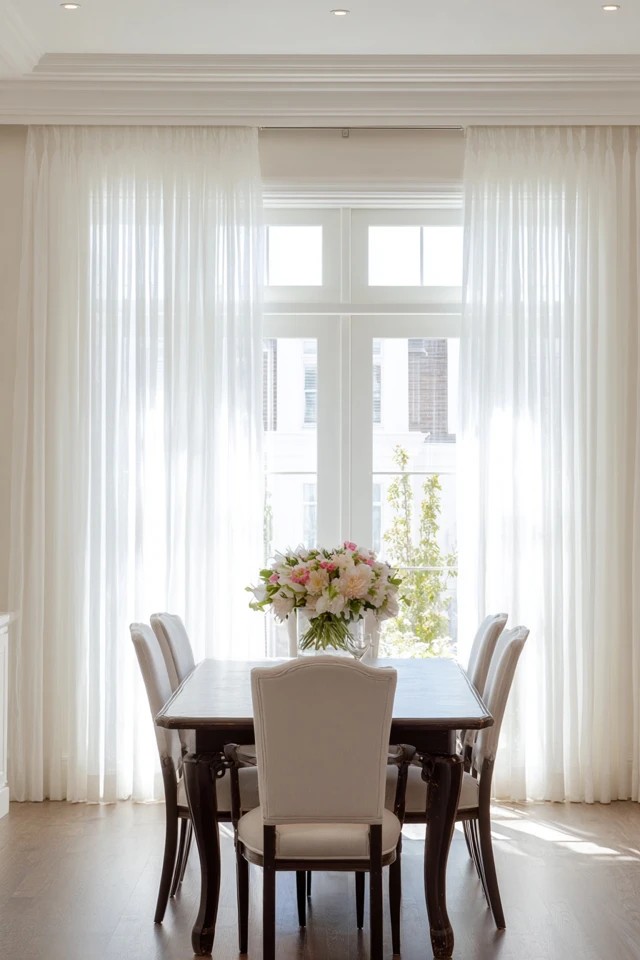
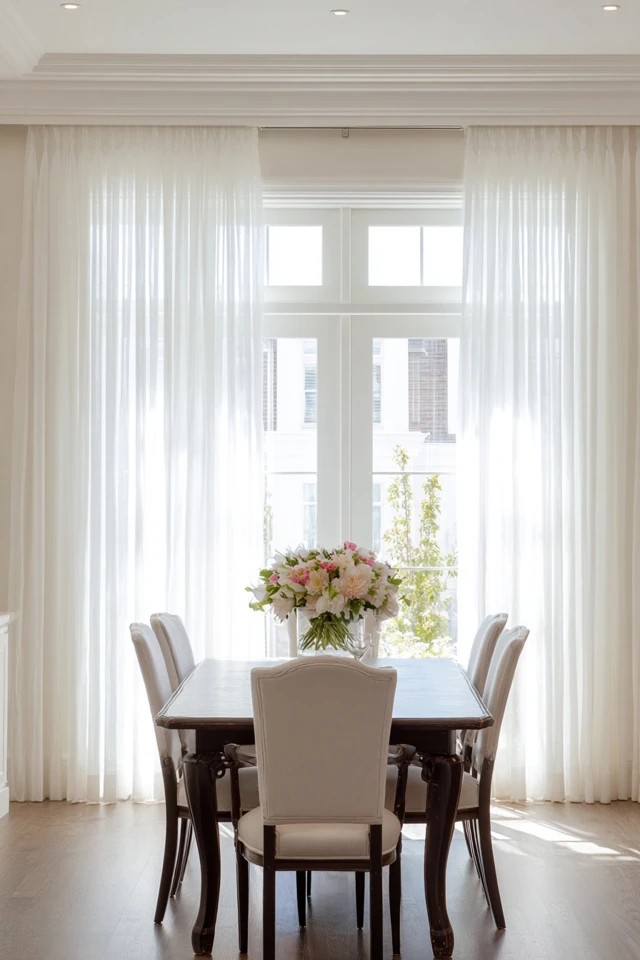
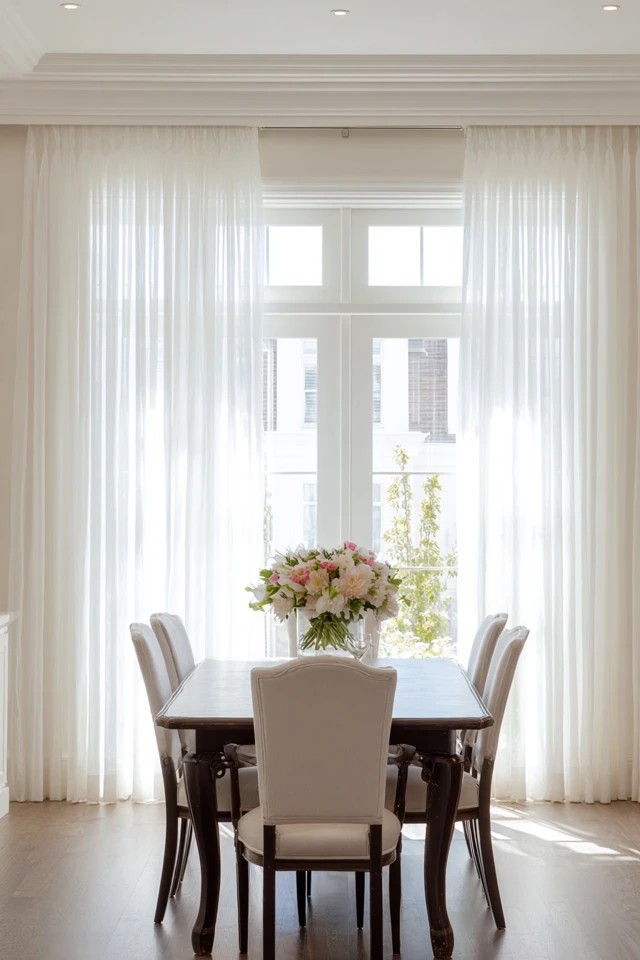
Floor-to-ceiling sheer white curtains achieve effortless elegance in a formal dining room. Flowing panels of linen or voile soften architectural windows while allowing natural light to pour through in a gentle, diffused glow — luminous and airy without overwhelming the space. Paired with warm wood dining furniture, white sheers make candlelit dinners feel especially refined.
- Hang curtain rods at ceiling height to elongate the room visually.
- Choose natural linen or voile for the most refined, organic drape quality.
- Layer with a discreet blind behind for evening privacy without losing daytime elegance.
2. Bay Window with Built-In Bench Seating

A bay window transforms an ordinary dining room wall into a dynamic architectural feature. The angled geometry creates a natural nook that floods the room with light from three directions and provides a cozy spot that invites lingering long after the meal is done. Paired with built-in bench seating and lift-top storage beneath, it becomes a coveted design element.
- Use lift-top bench seating for hidden storage of linens and entertaining essentials.
- Choose performance fabric for cushions to handle everyday use and spills.
- Position the dining table to maximize window views and light from the bay.
3. Large Picture Window with Minimal Treatment

In modern dining rooms where the outdoor view is carefully considered, a large picture window with minimal or no treatment is the ultimate statement of confident restraint. The expansive glass becomes a living artwork — a frame for trees, gardens, or open sky that shifts with every season and time of day. For street-facing windows, smart glass provides on-demand privacy.
- Choose slim black or brushed metal window frames for a sleek, architectural look.
- Consider smart glass for privacy in street-facing picture windows.
- Keep furniture lines clean and simple to let the window remain the visual star.
4. Roman Shades in Neutral Linen
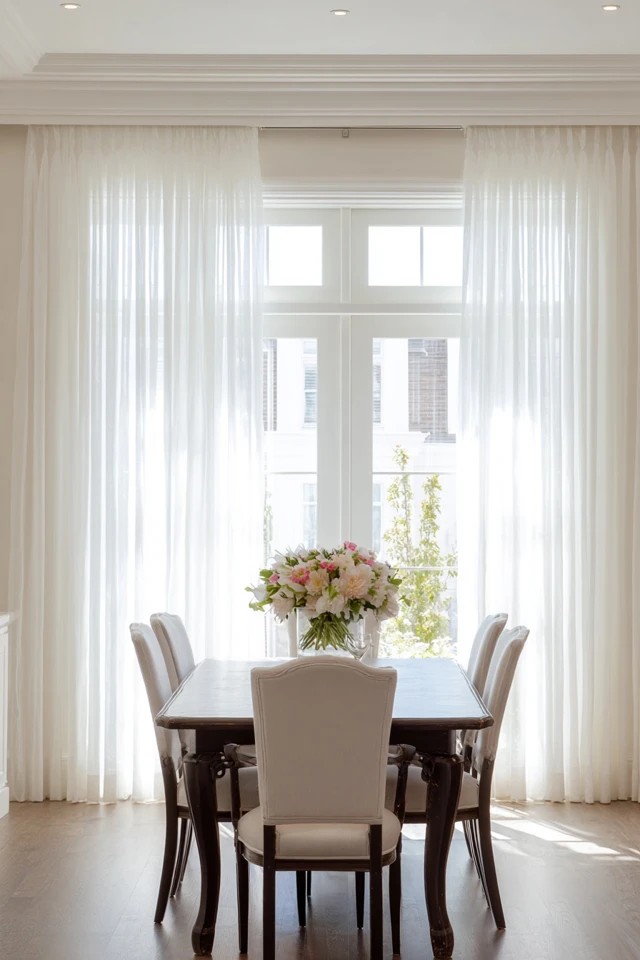
Roman shades represent the perfect marriage of form and function in a dining room window. The structured fabric folds that stack neatly when raised give a polished, tailored quality appropriate in both traditional and contemporary settings. In neutral linen — beige, warm grey, or natural flax — they complement virtually any color palette without competing for attention.
- Select blackout lining for west-facing dining windows prone to afternoon glare.
- Choose cordless or motorized operation for a cleaner, safer window treatment.
- Layer Roman shades with simple side panels for added softness and dimension.
5. French Doors with Transom Windows

French doors with transom windows above create a window wall of extraordinary elegance, flooding the dining room with light from floor to ceiling. The classical proportions pair beautifully with formal furniture and a chandelier that reflects magnificently in the glass panels at night. The doors open to a patio or garden, extending dining outdoors on warm evenings.
- Install operable transoms above French doors for natural ventilation.
- Choose hardware finish that coordinates with the dining room’s other metal accents.
- Use sheer panels on French doors for privacy without obscuring the architectural beauty.
6. Stained Glass Window for Artistic Character

A stained glass window brings something no other treatment can offer — color, pattern, and light transformed into a moving artwork that shifts with the sun. In a craftsman dining room, art glass panels in amber, green, and blue create a jewel-like effect deeply rooted in the Arts and Crafts tradition. Leaded glass overlays can approximate the look at lower cost.
- Commission a local glass artist for a custom panel tailored to your window dimensions.
- Position stained glass on east or west walls to maximize sun-activated color effects.
- Coordinate glass colors with the dining room’s existing palette for cohesive design.
7. Window Seat with Cushions for a Cozy Nook

A window seat beneath a dining room window transforms unused space into a cushioned nook that invites reading between meals or quiet coffee with a view. In a cottage dining room, the built-in quality adds to the sense of a space that has evolved thoughtfully over time. A thick foam cushion in a cheerful stripe or botanical print adds comfort and personality.
- Build the window seat depth at least 18 inches for comfortable lounging.
- Choose durable, washable fabric for cushions in a dining-adjacent setting.
- Add a hinged lid for convenient storage of table linens and placemats beneath.
8. Café Curtains for Farmhouse Privacy and Charm

Café curtains — panels covering only the lower half of a window — offer genuine privacy where it matters most while allowing light through the uncovered upper portion. In a farmhouse dining room, white cotton or linen café curtains bring honest, unpretentious charm. Seated guests sit at the lower window half, so street-level views are blocked while natural light floods in from above.
- Mount the rod at window mid-height for maximum privacy at seated eye level.
- Choose 100% cotton or linen for authentic farmhouse texture and easy laundering.
- Add a simple top valance to complete the window frame without blocking upper light.
9. Plantation Shutters for Classic Versatility
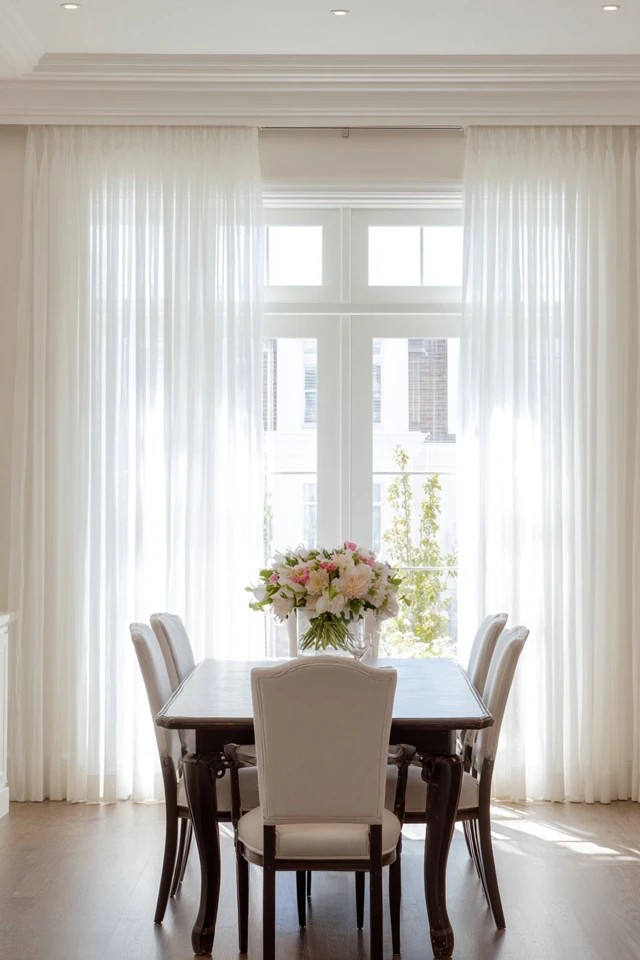
Plantation shutters are among the most enduringly popular window treatments in dining room design. Adjustable louvers offer precise control over the quality and direction of natural light, while painted wood construction adds genuine architectural detail. White painted shutters against cream walls create refined elegance that never goes out of style.
- Select 3.5-inch louvers for standard windows, 4.5-inch for larger or taller windows.
- Choose real wood for painted shutters; composite for high-humidity dining spaces.
- Install with a center divider rail for independent upper and lower louver control.
10. Arched Window for Mediterranean Architectural Drama

An arched window introduces classical architecture that immediately elevates a dining room’s design ambition. The curved top — whether a full semicircle, elliptical arch, or subtle radius — evokes the sun-warmed courtyards of Mediterranean design. In a room furnished with terracotta, aged wood, and hand-painted ceramics, an arched window completes the aesthetic with genuine authority.
- Leave the arch uncovered to preserve the curved silhouette as a design feature.
- Use a shaped shutter or Roman shade below the arch for practical light control.
- Complement arched windows with rounded furniture profiles and curved accessories.
11. Bamboo Blinds for Natural Organic Texture

Bamboo blinds bring an irreplaceable quality of natural texture to the dining room window — warmth and organic character no synthetic material can replicate. Woven from split bamboo or matchstick reeds, these shades cast beautiful striped light patterns across walls and tabletops. In a dining room with live-edge wood tables and rattan chairs, bamboo blinds tie the entire material story together.
- Choose tighter weave density for rooms that receive direct afternoon sun.
- Add a blackout liner behind open-weave bamboo for flexible light control.
- Coordinate bamboo tones with other natural wood elements in the dining room.
12. Clerestory Windows for Modern Privacy and Brightness

Clerestory windows — positioned high on the wall near the ceiling — allow abundant daylight to flood in without window treatments, since the glass sits above the sightline of people outside. Light bounces off the ceiling and upper walls, creating soft, diffused illumination difficult to achieve with conventional window placement. They are especially valuable in urban dining rooms where street-level privacy is a concern.
- Use operable clerestory windows to create a natural stack-effect ventilation system.
- Paint the ceiling and upper walls white to maximize light reflection from the glazing.
- Consider solar control glass in clerestory windows to manage summer heat gain.
13. Decorative Valance with Ornate Hardware

A decorative valance with ornate hardware elevates the dining room window the way fine jewelry elevates an outfit. In a traditional dining room, a valance in silk damask or embroidered linen mounted on a gilded rod with decorative finials creates a window crown of genuine elegance. Use it alone for a light look, or pair it with side panels for a fully layered, formal treatment.
- Select valance length at one-fifth of total window height for ideal proportion.
- Coordinate fabric color and pattern with dining chair upholstery for visual cohesion.
- Choose hardware finish that matches or complements the chandelier and room’s metal accents.
14. Corner Windows for Wraparound Panoramic Light

Corner windows that meet at an angle — eliminating the traditional corner wall — create one of the most dramatic window experiences in residential design. In a contemporary dining room, this architectural gesture floods the space with natural light from two directions, dissolving the boundary between interior and exterior. At night, the corner of glass becomes a dark mirror reflecting the chandelier and candlelit table.
- Position the dining table centrally to enjoy light and views from both window planes.
- Use individual roller shades per panel to preserve the clean corner junction.
- Install frameless corner windows with minimal profile mullions for maximum visual impact.
15. Garden Window Box for a Botanical Feature

A garden window box transforms an ordinary dining room window into a living design feature. In a cottage dining room, a window shelf lined with potted herbs — basil, rosemary, mint — creates a farm-to-table connection with fresh garnishes within arm’s reach of the table. An exterior box planted with trailing petunias creates a colorful living frame visible from inside.
- Choose herbs suited to your window’s light — basil needs full sun, mint tolerates shade.
- Install exterior window boxes with proper waterproofing to protect the window frame.
- Mix trailing and upright plants in exterior boxes for layered visual interest.
16. Black Window Frames for Modern Graphic Impact
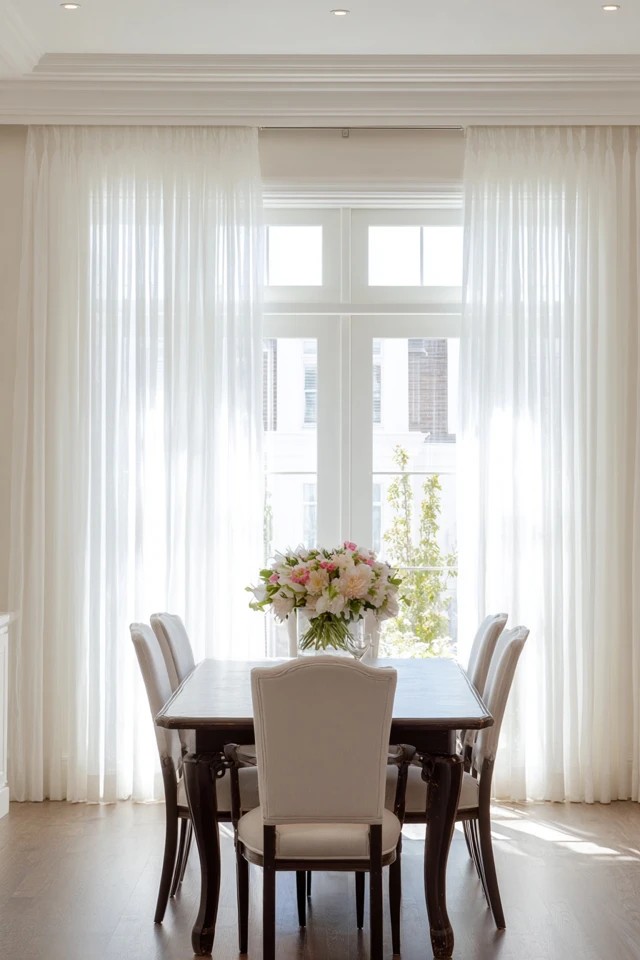
Black window frames have become one of the most coveted design elements in contemporary interiors. Against white or light walls, black-painted wood or dark metal frames create bold graphic contrast that reads as definitively modern — precise, confident, and architecturally resolved. Pairing them with a matte black light fixture and thin black chair legs creates a cohesive thread without feeling heavy.
- Coordinate black window frames with black hardware, light fixtures, and furniture details.
- Use white or light walls to maximize the graphic contrast of dark frames.
- Avoid heavy curtains on black-framed windows — let the frames speak for themselves.
17. Intricate Window Trim Molding for Victorian Elegance

In a Victorian dining room, intricate trim molding transforms an ordinary window into a statement of architectural craftsmanship. Layered casing profiles, decorative corner rosettes, and pediment-style header details create depth and shadow that shift beautifully throughout the day. Crisp white trim against a richly colored wall — deep burgundy, forest green, or navy — makes the most of this sculpted quality.
- Research period-correct molding profiles for your home’s specific Victorian sub-style.
- Use a bold wall color behind white trim to maximize the molding’s visual impact.
- Restore rather than replace original Victorian trim whenever structurally possible.
18. Skylight Above Window for Enhanced Overhead Light

The combination of a conventional wall window with a skylight directly above creates a dining room lighting experience that transcends what either achieves alone. The wall window provides horizontal view connection, while the skylight introduces overhead illumination that eliminates harsh shadows and flatters both food and faces at the dining table. Tubular skylights offer an efficient alternative where full skylights are not structurally feasible.
- Install a skylight with a motorized shade for control of summer heat gain.
- Position the skylight directly above the dining table for the most flattering overhead light.
- Use a tubular skylight in rooms below upper floors where full skylights are not feasible.
19. Window Positioned Behind Buffet for Backlit Drama
Positioning a buffet or sideboard in front of a dining room window creates one of the most dramatically beautiful compositions in traditional dining room design. Natural light streaming in from behind creates a luminous backlighting effect that elevates every displayed object — flowers, decanters, a silver candelabra — into something almost sculptural. Afternoon light turns crystal decanters into glowing amber jewels.
- Apply UV-blocking window film to protect the buffet’s finish from sun damage.
- Display reflective or translucent objects on the buffet to maximize the backlighting effect.
- Use Roman shades behind the buffet to modulate light intensity throughout the day.
20. Motorized Window Shades for Smart Home Integration
Motorized window shades represent the intersection of sophisticated design and contemporary technology. In a contemporary dining room, shades that rise and fall at the touch of a remote, smartphone app, or voice command provide precision light control that manual treatments cannot match. Eliminating cords and pulls entirely, they achieve a visual cleanliness impossible with conventional treatments.
- Program preset shade positions for morning light, afternoon glare reduction, and dinner ambiance.
- Install a recessed roller pocket above the window for a completely clean, cornice-free look.
- Integrate with smart lighting so shades and artificial light adjust together seamlessly.
Why These Dining Room Window Ideas Excel
The twenty dining room window ideas in this article span the full spectrum of design possibility — from traditional plantation shutters and Victorian window trim to contemporary motorized shades and minimalist picture windows — each selected for aesthetic excellence and practical functionality that serves real homeowners every day.
At the heart of every successful dining room window treatment is the management of natural light quality. Whether through sheer curtains, plantation shutter louvers, bamboo blinds, or a skylight overhead, each idea addresses the challenge of making natural light work beautifully across morning breakfasts, afternoon gatherings, and candlelit dinner parties alike.
Architectural character is another defining thread. The bay window with built-in bench, the arched Mediterranean window, the bold black-framed statement, and the intricately molded Victorian casing all demonstrate that the window itself — independent of any treatment — can serve as a primary design element. Investing in architecturally distinctive windows pays lasting dividends.
The indoor-outdoor connection that dining rooms facilitate is uniquely powerful. French doors, large picture windows, corner windows, and garden window boxes all prioritize the relationship between the dining room and the landscape beyond. Access to natural views during meals improves mood and enhances social interaction — making view-maximizing window design a genuinely lifestyle-improving investment. Privacy is equally addressed: café curtains, clerestory glazing, shutters, and Roman shades each solve the privacy equation without compromising light or design integrity.
Conclusion
Your dining room windows are among the most powerful design tools at your disposal — capable of transforming natural light, spatial character, and the overall atmosphere of one of your home’s most socially significant rooms. Whether your vision is a sun-drenched modern dining room with corner windows and motorized shades, a romantic traditional space dressed in silk valances and plantation shutters, or a cottage dining room with café curtains and a cushioned window seat, these twenty ideas offer a comprehensive starting point for every style and budget.
Invest in quality materials, experiment with layered treatments, and let these ideas inspire a dining room as individual and inviting as the family it serves.

Andrew is the founder and lead writer at RoomBlossom, a home decor publication dedicated to practical, intentional interior design. With over 10 years of hands-on experience transforming real-world living spaces — from compact apartments to full attic conversions — Andrew specialises in room design that balances visual appeal with everyday function. His work spans living rooms, bedrooms, sunrooms, and attic spaces, always guided by the belief that great design should work for the people who live in it, not just look good in photographs.