
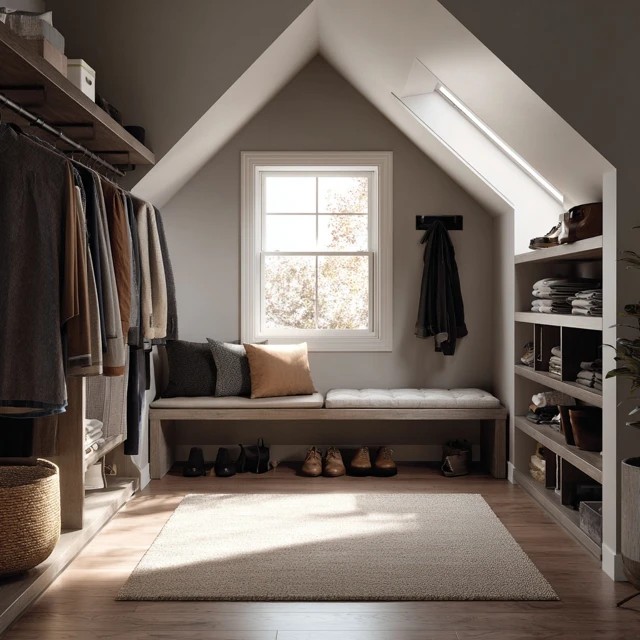
An attic walk-in closet is one of home design’s most aspirational achievements — a dedicated dressing room where both walls are lined with bespoke cabinetry, a central aisle allows unhurried browsing, and a skylight creates ideal conditions for colour-accurate outfit assessment.
Here are 20 attic walk-in closet ideas spanning dual-wall wardrobe systems, central islands, shoe walls, specialised storage, boutique lighting, and finishing details — each one demonstrating how to create a walk-in closet that uses the attic’s architectural character as an asset rather than a constraint.
1. Built-In Wardrobes Along Both Walls for Comprehensive Storage
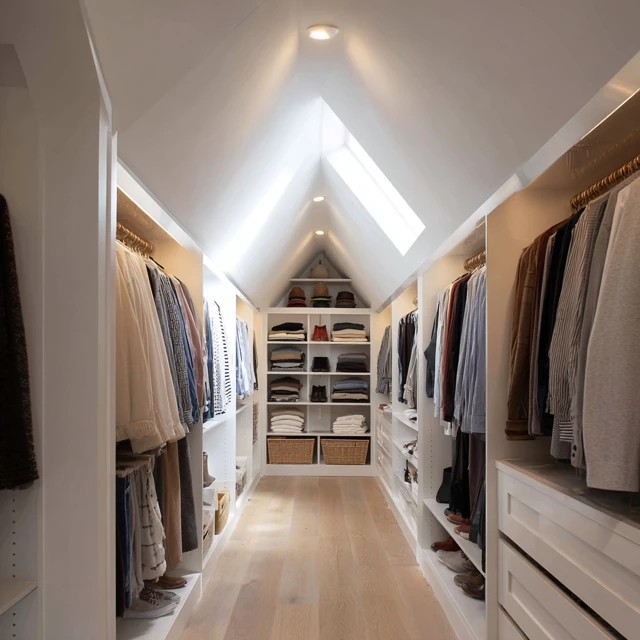
Floor-to-ceiling cabinetry lining both long walls of the attic walk-in closet — with a centre aisle wide enough for comfortable browsing and dressing — creates the most complete wardrobe storage available in any residential setting. The dual-wall format doubles the hanging, shelving, and drawer capacity of a single-wall system,
- Maintain a minimum 90cm centre aisle width for comfortable movement between both wardrobe walls.
- Build units to the exact slope angle at the top — a custom-fitted top panel eliminates the gap that standard units leave against a sloped ceiling.
- Use the same door style on both walls for visual balance and a cohesive, boutique dressing room appearance.
2. Central Island with Drawers for Boutique Accessory Storage
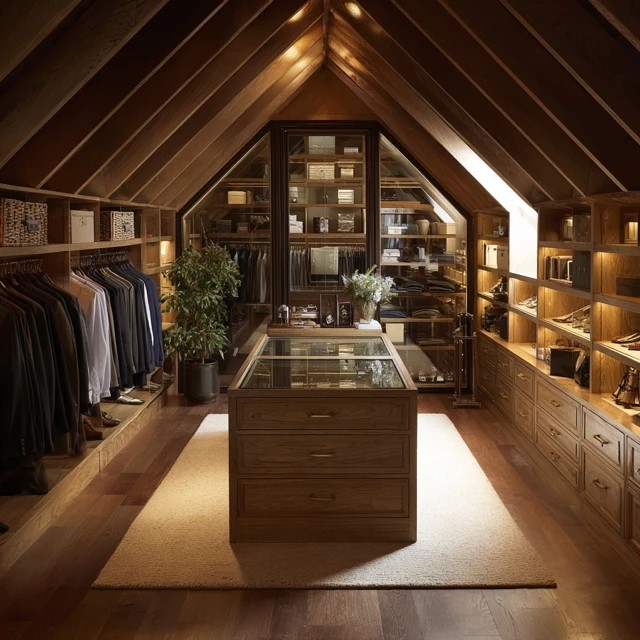
A central island — a freestanding chest of drawers with a glass or marble top — placed in the aisle between the two wardrobe walls gives the attic walk-in closet the definitive feature of a luxury dressing room. The island’s multiple drawers house jewellery, folded accessories, and small items in organised, accessible compartments,
- Size the island so it leaves at least 60cm of clear aisle on each side for comfortable standing and drawer access.
- Choose a marble or tempered glass top surface for the island to introduce a luxury material quality at the most-touched surface.
- Include at least six drawers in the island — a mix of shallow jewellery trays and deeper accessory drawers — for maximum internal variety.
3. Full-Length End-Wall Mirror for Outfit Assessment
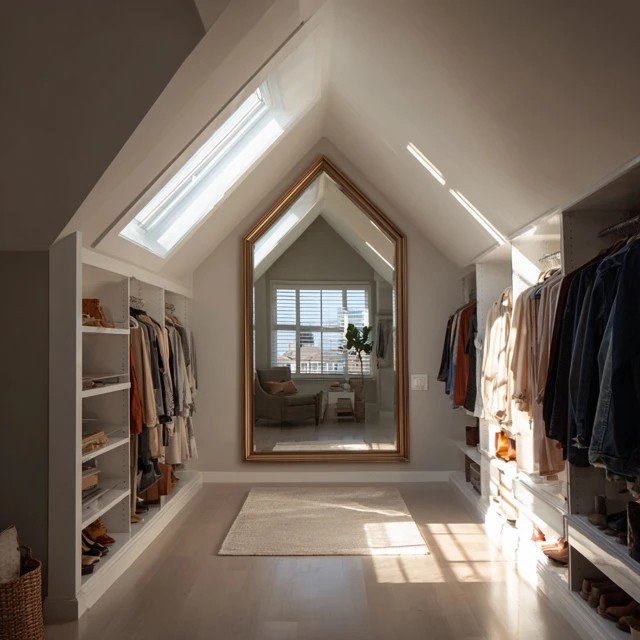
A full-length mirror mounted on the end wall — the gable wall where ceiling height is greatest — creates the most important functional element of any walk-in closet: the ability to assess a complete outfit from head to foot before leaving the dressing room.
- Use a frameless mirror for the most expansive, uninterrupted reflective surface on the end wall.
- Position the mirror so natural skylight illumination falls on the viewer’s face rather than creating a backlit silhouette effect.
- Mount mirror lighting on the wall to the left and right of the mirror at face height for even, flattering outfit assessment light.
4. LED Lighting Strips for Focused Wardrobe Illumination
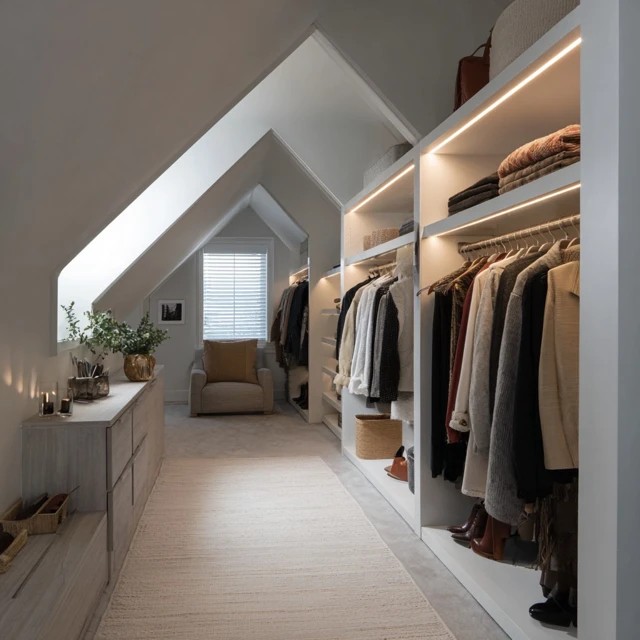
LED strips mounted inside shelving bays, along the front edges of shelf surfaces, and beneath hanging rails provide the even, shadow-free task illumination that makes a walk-in closet genuinely functional at any hour.
- Choose warm-white LEDs (2700-3000K) for the most accurate fabric colour rendering inside the wardrobe.
- Install LED strips on the underside of each shelf so light falls downward onto the shelf below — the most practical position for visibility.
- Connect all closet LEDs to a single switch at the entry point for one-touch activation on arrival each morning.
5. Dedicated Shoe Wall for Organised Footwear Display
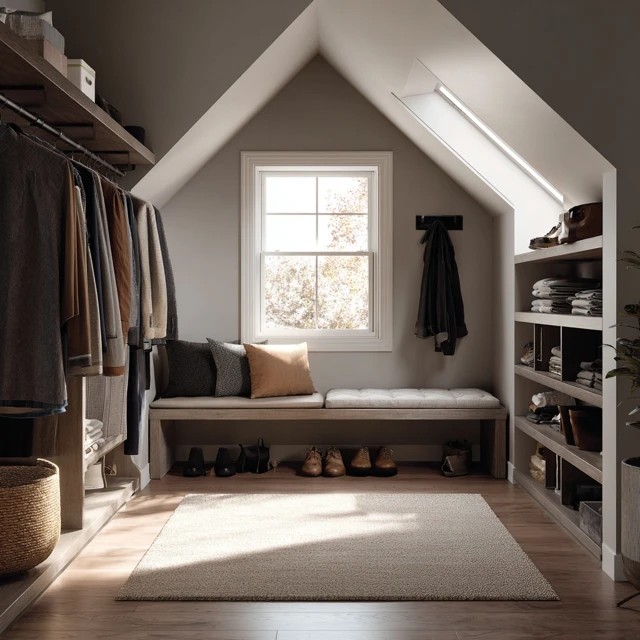
An entire wall of floor-to-ceiling angled shoe shelves creates a footwear display that combines the practical function of organised, accessible storage with the visual appeal of a shoe boutique — each pair presented at a slight forward tilt, style visible at a glance, with boots at the bottom, heels in the middle, and flat shoes and trainers at the top sections where ceiling height diminishes.
- Set shoe shelf spacing at 15cm for flats, 18cm for heeled shoes, and 35cm for tall boots at the lower sections.
- Use angled shelves rather than flat ones — the tilt presents each shoe’s style while keeping pairs naturally together.
- Install a small LED strip beneath each shoe shelf row for individual illumination of the collection at any hour.
6. Valet Hook and Bench for Outfit Staging
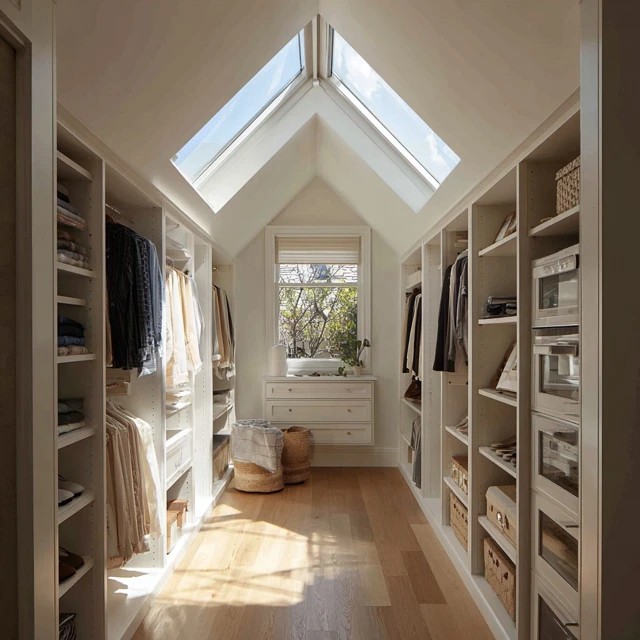
A mounted valet hook beside a small upholstered bench creates a dedicated staging area for tomorrow’s outfit — the single most practical daily efficiency feature a walk-in closet can contain. Assembling the next day’s complete outfit on the valet hook each evening eliminates morning decision-making entirely, and
- Mount the valet hook at a height that allows a full outfit — jacket, shirt, and trousers — to hang without touching the floor.
- Position the bench beside the shoe storage section so footwear can be selected and put on in the same seated position.
- Add a small tray or hook cluster adjacent to the valet for accessories — watch, rings, belt — associated with the staged outfit.
7. Skylight for Natural Dressing Room Illumination
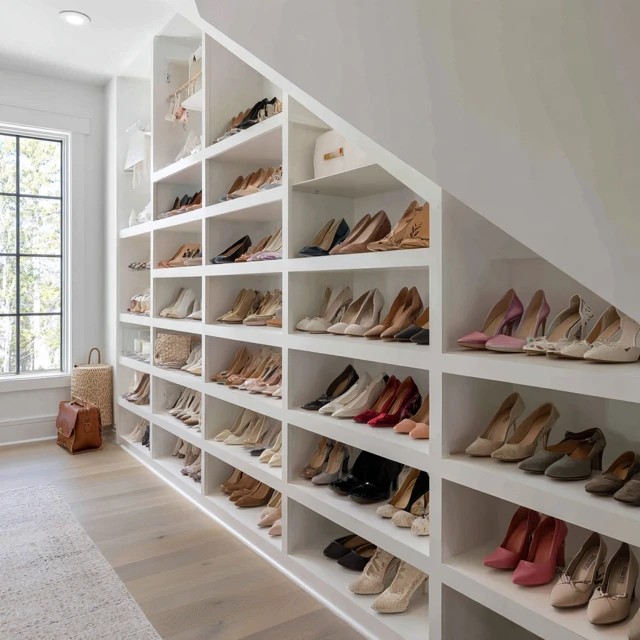
A skylight positioned centrally over the walk-in closet aisle provides the most valuable illumination available for a dressing space — natural daylight that renders fabric and leather colours accurately, eliminating the colour-shifting effect of artificial lighting that causes wardrobe mismatches visible only in outdoor light.
- Install a diffusing glazing type in the skylight — direct sunlight creates harsh shadows on the displayed clothing and fades fabrics over time.
- Apply UV-filtering film to the skylight glass to protect the entire clothing collection from ultraviolet colour degradation.
- Choose a roof window with an opening mechanism so the dressing room benefits from ventilation as well as natural light.
8. Jewellery Drawer Organiser for Accessory Protection
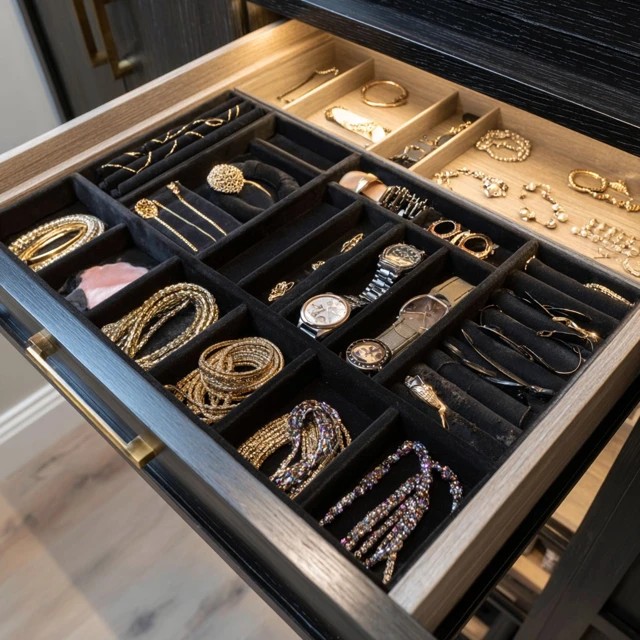
A velvet-lined drawer with individual compartments for rings, earrings, necklaces, bracelets, and watches protects the jewellery collection from tangling and scratching while making each piece visible and immediately selectable.
- Choose a velvet liner in a contrasting colour to the primary jewellery tones — grey for gold, navy for silver — for easy visual identification.
- Include ring rolls, earring bars, and necklace hooks within the drawer to accommodate all jewellery types without adaptation.
- Position the jewellery drawer at standing height — 90-100cm from floor — for comfortable selection without bending.
9. Colour-Coded Wardrobe Organisation for Visual Harmony
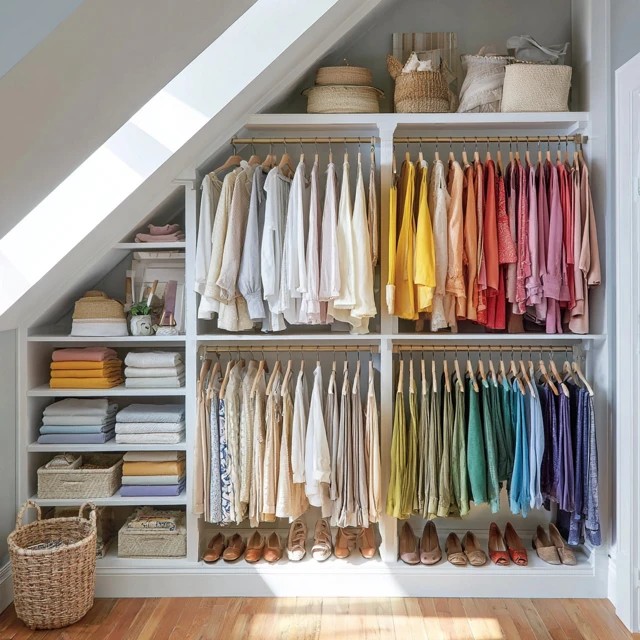
Organising the walk-in closet’s hanging garments in colour sequence — from white through cream, pastels, blues, greens, earth tones, deep jewels, and black — creates a wardrobe that is simultaneously visually beautiful and practically efficient.
- Apply the colour system separately within each garment type — all shirts in colour order, then all jackets in colour order — for maximum logic.
- Re-sort garments after each laundry return to maintain the system’s accuracy rather than allowing gradual disorder to accumulate.
- Position the most-worn colour sections at the most accessible aisle height — eye level and slightly below — for the easiest daily access.
10. Pull-Out Trouser Rack for Crease-Free Storage
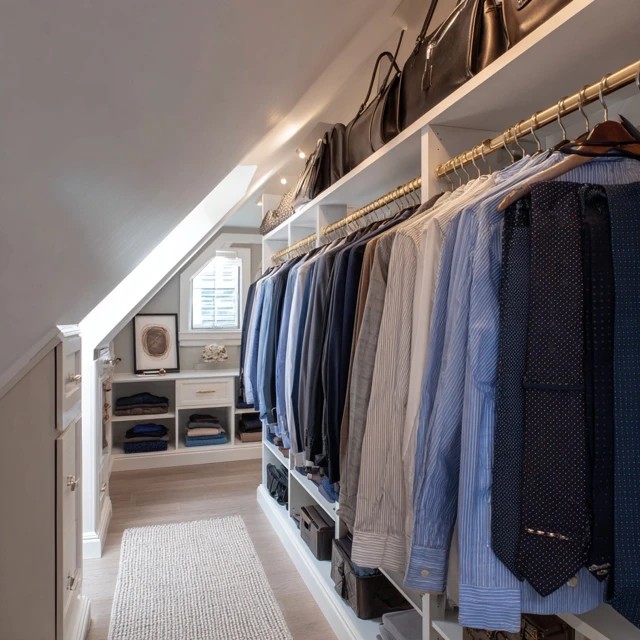
A pull-out rack with individual horizontal bars for each pair of trousers — extending from the cabinet on full-extension runners and retracting completely when not in use — stores trousers draped over the bars without creasing the fabric at the fold point that a standard hanger creates.
- Install a rack with at least 10-12 individual bars for a comprehensive trouser collection without overcrowding.
- Position the pull-out at 70-80cm from the cabinet base for comfortable trouser draping and retrieval without bending.
- Choose chrome or brushed nickel bar finishes that coordinate with the other metal hardware throughout the walk-in closet.
11. Belt and Tie Rack for Organised Accessory Storage
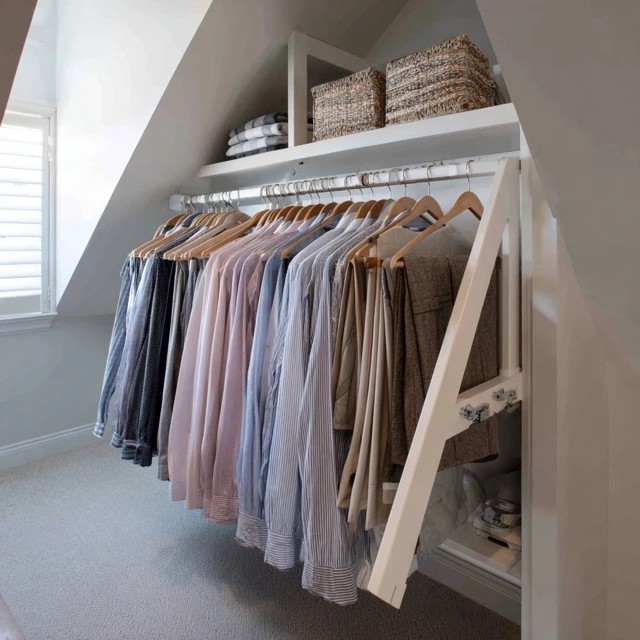
A dedicated pull-out rack for belts and ties — individual hooks for belts to hang from their buckles, and a horizontal bar for ties draped over their centre — organises accessories that would otherwise tangle in a drawer or hang chaotically from a single hook.
- Allow at least 2cm spacing between belt hooks to prevent buckles from overlapping and scratching adjacent belts.
- Install a separate tie bar above the belt hooks so both accessories share one pull-out unit without competing for the same hanging space.
- Position the combined accessory rack adjacent to the shirt hanging section for the most efficient morning dressing workflow.
12. Built-In Hamper for Concealed Laundry Storage
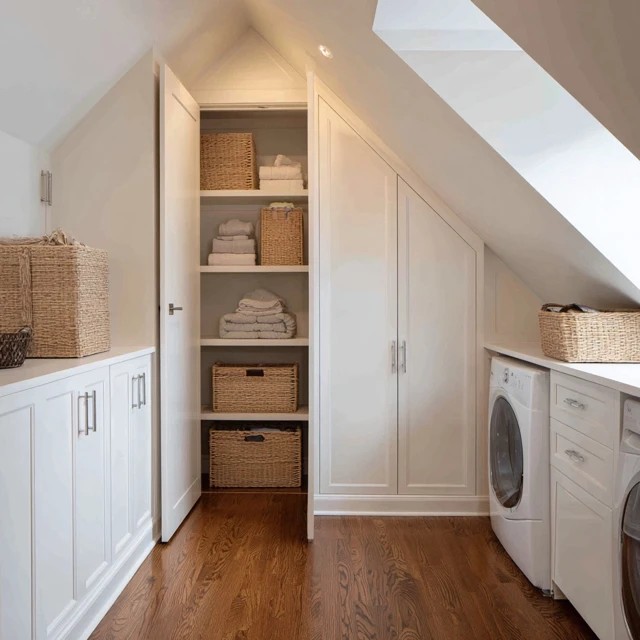
A pull-out hamper built into the base section of the wardrobe cabinetry — concealed behind a flush door that matches the surrounding panels — keeps dirty laundry in the most logical location, the room where clothing is removed, while maintaining the walk-in closet’s clean visual appearance.
- Build the hamper compartment with ventilation slots in the sides to prevent odour development from stored dirty clothing.
- Use a removable fabric bag liner inside the hamper frame for easy extraction and direct transfer to the washing machine.
- Size the hamper to accommodate at least one full wash load — a too-small hamper requires constant emptying that defeats its convenience purpose.
13. Exposed Wood Beams for Rustic Architectural Character
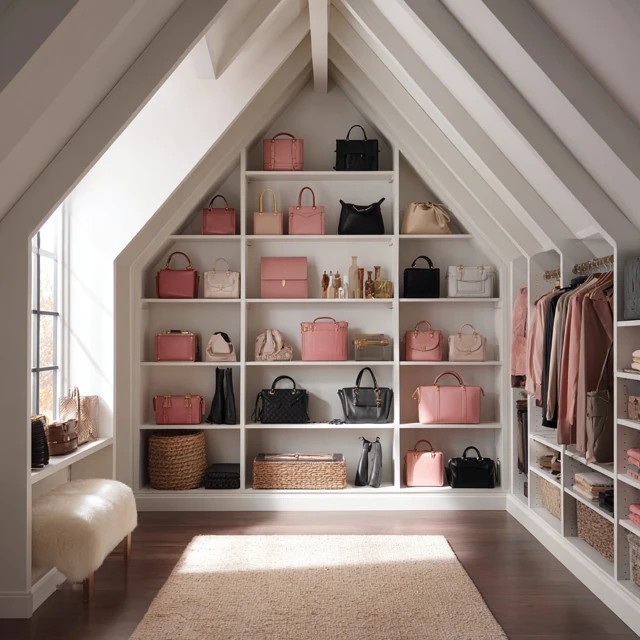
Exposed structural beams in the attic walk-in closet overhead create an unexpected and deeply attractive juxtaposition — the rustic authenticity of old timber alongside the refined luxury of bespoke white cabinetry, velvet-lined drawers, and a collection of carefully chosen clothing.
- Clean and treat exposed beams with a penetrating oil to enhance the natural grain without adding any artificial varnish sheen.
- Use white cabinetry beneath and around the beams for maximum tonal contrast that makes the dark beams the room’s defining feature.
- Install pendant lights from the beam structure rather than the ceiling plaster for a visually connected lighting solution.
14. Dedicated Bag and Purse Shelving for Handbag Display
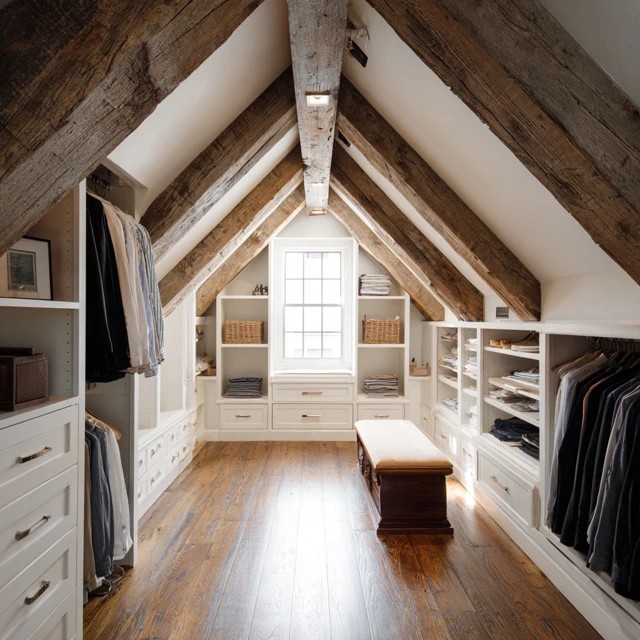
Open shelves in a section of the walk-in closet cabinetry — sized specifically for standing handbags and clutches with sufficient depth to support structured bags without crushing their sides — display the handbag collection in a boutique format where every piece is visible and selectable without reaching into a dark cabinet.
- Set shelf spacing at 30-35cm for standard handbags and 45-50cm for oversized totes and weekend bags.
- Line bag shelves with suede or velvet adhesive material to protect bag bases from the hard shelf surface.
- Position the most-used everyday bags at the most accessible aisle height and display statement occasion bags as the visual highlight above.
15. Built-In Dresser Under the Slope for Fitted Storage
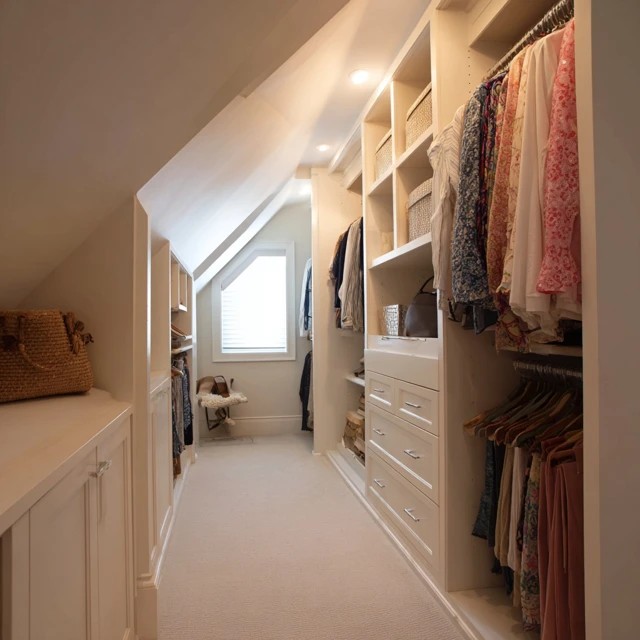
A chest of drawers built to fit precisely beneath the sloped ceiling zone — where full-height wardrobe units would not fit but drawer access requires no standing clearance — uses the walk-in closet’s most constrained architectural zone for one of its most practical storage functions.
- Build the dresser top surface as a continuous worktop that connects to adjacent cabinetry for a fully seamless integrated appearance.
- Use full-extension drawer runners rated well above the anticipated load for reliable, smooth daily operation over many years.
- Mount a small mirror or picture on the sloped wall section above the dresser to complete the visual composition in this zone.
16. Chandelier or Pendant Light for Elegant Ambient Illumination
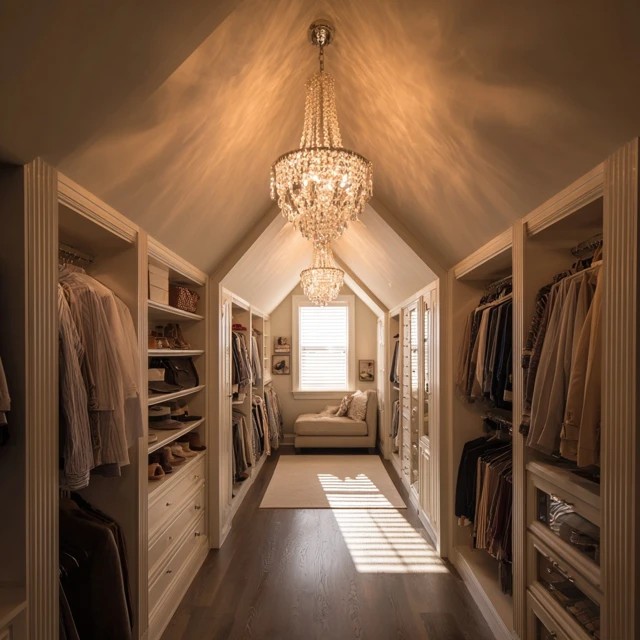
A decorative chandelier or oversized pendant light centred in the walk-in closet aisle adds the defining luxury touch that distinguishes a genuinely boutique dressing room from a functional storage room. Hung at the ridge point where ceiling height is greatest, the fixture provides ambient general illumination while contributing the decorative focal point that makes the dressing room feel finished and celebrated.
- Choose a fixture sized for the aisle’s width — typically 30-40cm diameter maximum — so it illuminates the space without overwhelming it.
- Install the pendant on a dimmer switch so the ambient light level can be adjusted for different times of day and moods.
- Select a fixture that complements the metal finishes used on wardrobe hardware throughout the dressing room.
17. Seasonal Rotation System for Year-Round Wardrobe Management
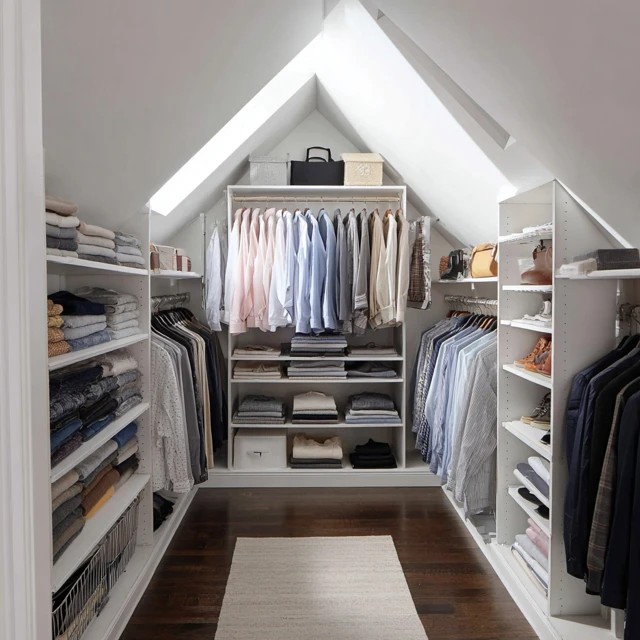
A deliberate seasonal rotation system — current-season garments in the most accessible, eye-level positions across both walls, and off-season items stored in labelled garment bags at the upper sections or in dedicated deep storage behind — maintains the active wardrobe section at a navigable, edited scale while keeping the full collection within the walk-in closet.
- Store off-season items in cotton garment bags rather than sealed plastic to allow the fabric to breathe during months of storage.
- Label each garment bag with its contents so the seasonal changeover can be completed without opening every bag to identify its contents.
- Use the seasonal rotation as a wardrobe audit — any item not worn in the past year is a candidate for removal from the collection.
18. Pull-Down Rod for High Ceiling Space Utilisation
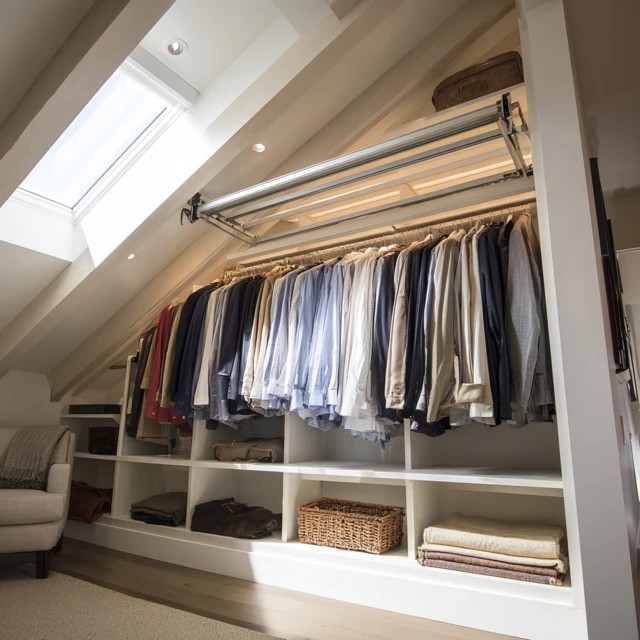
A pull-down rod mechanism installed at the highest available hanging height in the walk-in closet — where the ridge of the attic provides the most overhead clearance — uses the full ceiling dimension for garment storage while maintaining practical accessibility.
- Choose a pull-down rod rated for the total weight of garments it will hold at the highest stored position — typically 15-20kg minimum.
- Install the mechanism in the centre aisle section where both ceiling height and lateral clearance are greatest.
- Reserve the pull-down rail for lighter garments — shirts, blouses — rather than heavy coats that strain the spring mechanism.
19. White Painted Cabinetry for Bright Reflective Storage
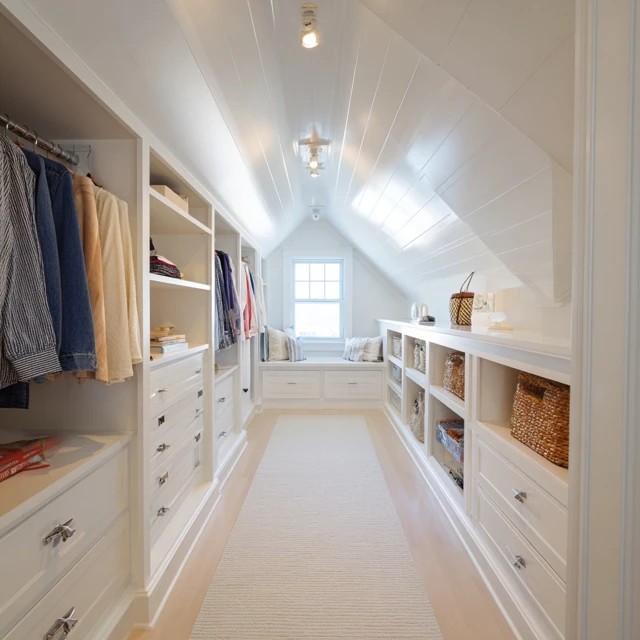
White-painted wood cabinetry throughout the walk-in closet — doors, shelves, drawer fronts, and frames all in the same crisp white — creates the most light-reflective and visually expansive interior available.
- Use a semi-gloss finish on cabinetry rather than flat paint for the best light reflectance and easier cleaning over time.
- Apply two coats of primer before the topcoat on cabinetry for a durable, chip-resistant painted surface.
- Match the white precisely across all cabinetry elements — slight colour variation between units is noticeable under good lighting.
20. Area Rug in the Aisle for Comfort and Definition
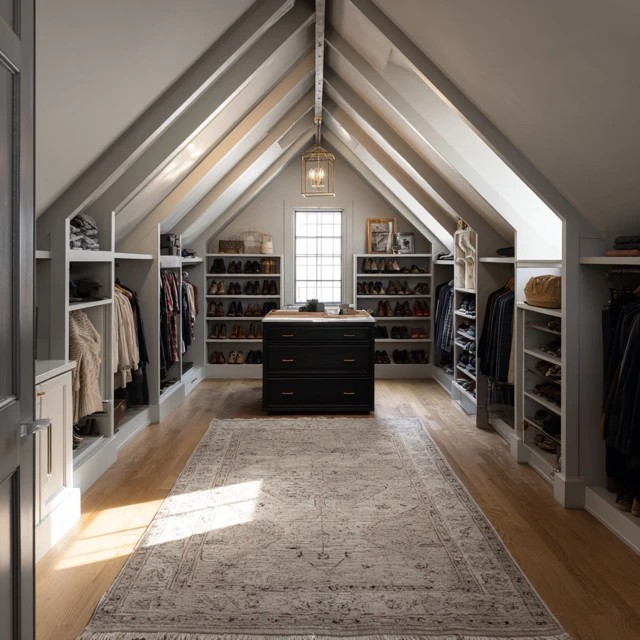
An area rug in the centre aisle of the walk-in closet provides the tactile warmth underfoot that transforms the daily dressing experience from functional to genuinely pleasurable — the first barefoot sensation of entering the dressing room each morning, and the comfortable standing surface for the often-extended process of outfit selection and accessory assembly.
- Size the rug to the full aisle length and a width of 60-80cm for a proportional, centred appearance in the space.
- Choose a flat-weave or low-pile rug for the walk-in closet aisle — thick pile creates trip hazards and catches clothing that brushes the floor.
- Select a pattern in neutral or complementary tones to the cabinetry colour — the rug should complement the wardrobe display, not compete with it.
Why These Attic Walk-In Closet Ideas Excel
Every idea on this list creates a walk-in closet that functions at boutique level — where every category has a purpose-designed storage position and lighting is calibrated for accurate colour assessment.
Storage completeness — dual-wall wardrobes, central island, shoe wall, trouser rack, jewellery drawer, and bag shelving — is what makes a walk-in closet a true dressing room. Each specialised element creates a system where every item has a logical home.
Light quality — skylight, LED strips, a pendant fixture, and a mirror — pays the highest daily dividend. A beautifully organised wardrobe in poor light is frustrating; the same wardrobe in excellent light is a daily pleasure.
Conclusion
An attic walk-in closet designed to boutique standards — dual-wall wardrobes, a central island, a dedicated shoe wall, specialist accessory storage, a skylight overhead, and a chandelier in the aisle — becomes one of the most valued and most used rooms in the entire house. Begin with built-in cabinetry fitted to the attic’s geometry, invest in quality lighting at every level, and add specialised storage for shoes, jewellery, and bags.

Andrew is the founder and lead writer at RoomBlossom, a home decor publication dedicated to practical, intentional interior design. With over 10 years of hands-on experience transforming real-world living spaces — from compact apartments to full attic conversions — Andrew specialises in room design that balances visual appeal with everyday function. His work spans living rooms, bedrooms, sunrooms, and attic spaces, always guided by the belief that great design should work for the people who live in it, not just look good in photographs.