

Working from home in an attic office is one of the most satisfying arrangements available — the physical separation from the household below, the overhead skylights, the exposed beams, and the quiet of a top-floor room create a workspace that no purpose-built office could replicate.
Here are 20 attic office ideas spanning desk placement, storage integration, ergonomic setups, and atmospheric design — each offering a fresh perspective on creating a productive workspace in a converted sloped-ceiling attic.
1. Desk at the Highest Ceiling Point for Ergonomic Comfort

Locating the primary work desk at the apex of the attic’s ceiling height — typically directly beneath the ridge — gives the seated worker the maximum available overhead clearance and the most generous sense of open space in what can otherwise feel like a compressed room.
- Confirm the ceiling height at the seated eye position before purchasing a monitor arm — the arm’s height must not conflict with the slope above.
- Orient the desk so the primary window is to one side rather than directly behind the monitor screen.
- Set the chair height so arms rest at a 90-degree angle on the desk surface with shoulders fully relaxed.
2. Built-In Shelving Along the Knee Walls for Integrated Storage

Commissioning built-in shelving along the knee walls — fitted precisely to the available height at the point where the slope meets the floor — creates a storage system that uses the attic’s most common unused zones as genuinely valuable office organisation.
- Use the taller knee wall section (24-30 inches) for open bookshelves and the shorter section (12-18 inches) for deep drawers.
- Paint built-in shelving in the same colour as the walls for an integrated, architectural result rather than a furniture-like one.
- Install a narrow LED strip along the inside top of each shelf bay for subtle illumination of stored items.
3. Skylight Positioned Over the Desk for Optimal Natural Light
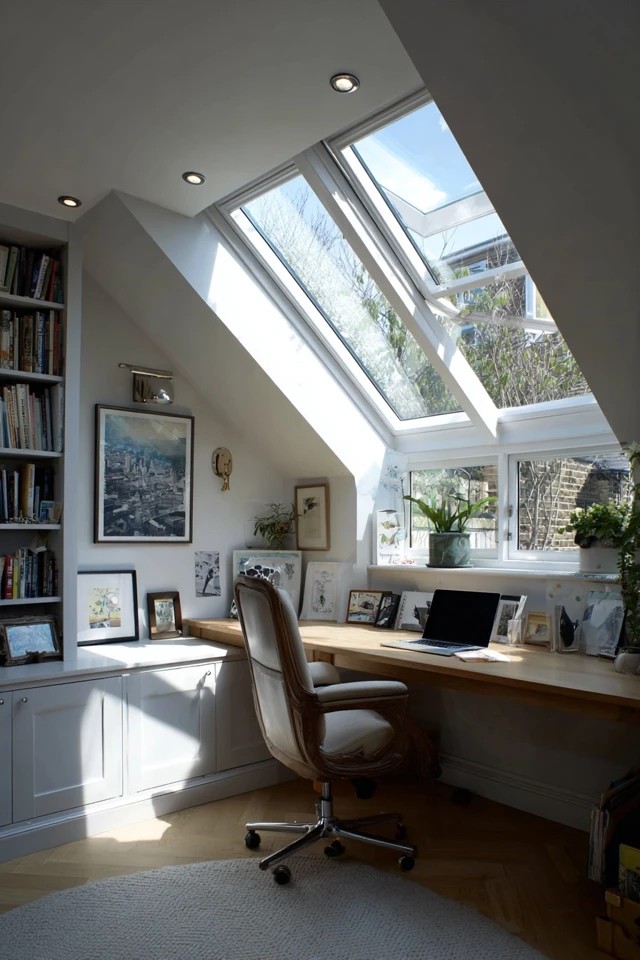
A skylight installed in the roof slope directly above the primary desk position delivers the most practical natural light available for sustained knowledge work — bright, evenly distributed, and without the directional shadows that side windows create.
- Choose a roof window with a tilt-and-turn opening rather than a fixed unit to provide ventilation alongside light.
- Install a manually or electrically operated roller blind within the skylight unit for glare management at peak sun hours.
- Pair the skylight with a high CRI artificial light source for evening work that maintains colour accuracy after dark.
4. All-White Walls and Ceiling for Maximum Light Reflection

An all-white interior — walls, sloped ceiling, beams, and trim painted in the same crisp white — creates the most light-maximising attic office environment available. Natural light entering from dormer windows and skylights reflects off every white surface and reaches all areas of the workspace, creating an energising brightness that supports concentration and prevents the visual fatigue associated with dark, poorly lit work environments.
- Choose a bright white with a slight warm undertone — pure cool white can feel antiseptic in a space occupied all day.
- Apply a flat finish on ceiling surfaces and a washable eggshell on the walls for practical long-term maintenance.
- Add a single large green plant as the only non-white accent — its natural form reads as relief rather than clutter.
5. L-Shaped Corner Desk for Maximum Work Surface Area
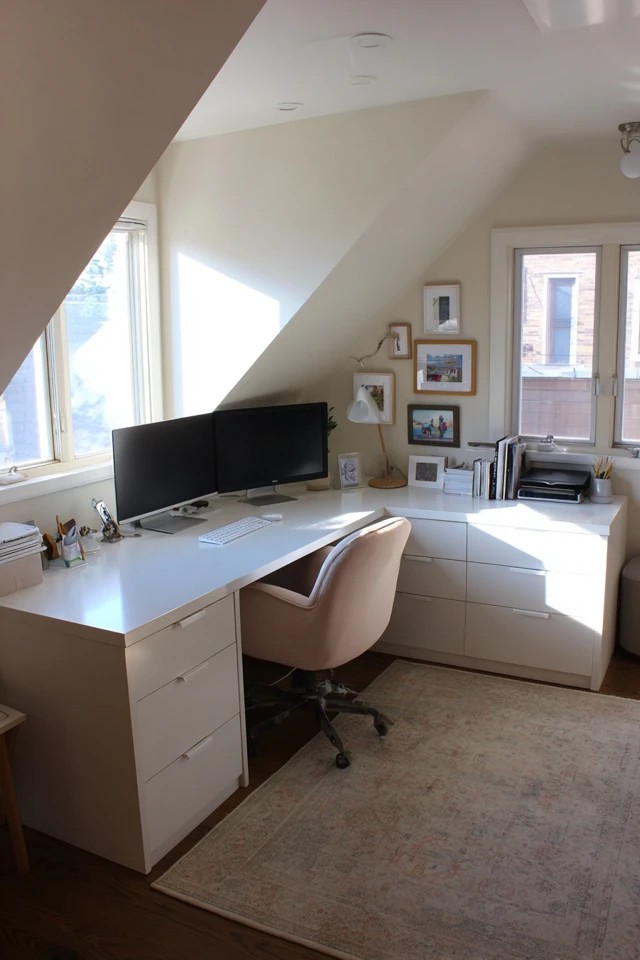
An L-shaped desk fitted into a corner of the attic office provides a continuous work surface that no single straight desk can match — one arm serves as the primary monitor and keyboard position while the other accommodates reference documents, a second screen, a notebook, or equipment that needs to remain accessible without cluttering the primary work zone.
- Place the monitor-facing arm perpendicular to the window for side lighting that prevents direct screen reflection.
- Keep the secondary arm at the same height as the primary for comfortable transition between both zones during the working day.
- Use a monitor arm rather than a stand on the L-desk to free the maximum amount of surface area for actual work.
6. Exposed Wood Beams as Architectural Feature

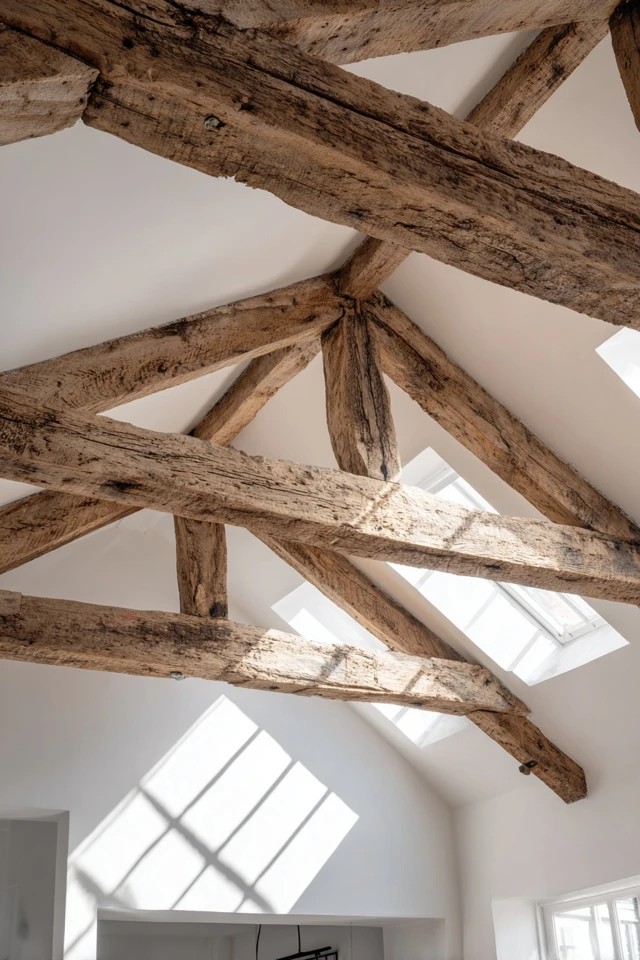
Leaving the attic’s structural beams exposed rather than covering them with plasterboard creates an office with architectural character and historical authenticity that no amount of applied decoration can replicate.
- Treat exposed beams with a light sandpaper and penetrating oil to enhance the grain without adding a thick, glossy varnish layer.
- Position recessed lights between rather than below the beams to preserve unobstructed sightlines to the structural ceiling above.
- Contrast dark beams with pale walls and a light desk — the visual counterpoint is what makes exposed beams beautiful rather than heavy.
7. Height-Adjustable Standing Desk for Physical Wellbeing
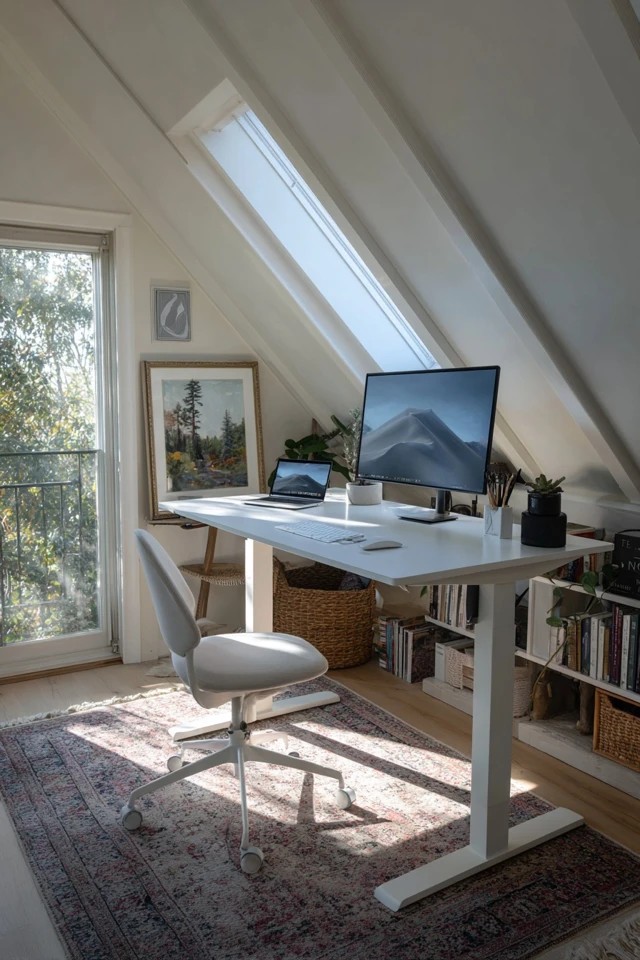
A motorised height-adjustable desk that transitions between seated and standing positions provides the ergonomic flexibility that all-day desk work requires for physical health.
- Verify that ceiling height at the standing desk position is at least 84 inches — standard standing height plus comfortable overhead clearance.
- Set a timer or use smart desk software to prompt position changes at 30-45 minute intervals throughout the day.
- Use an anti-fatigue mat at the standing position — even a few hours of standing without cushioning causes significant foot and lower back fatigue.
8. Filing Cabinet Under the Eave for Document Organisation
A lateral filing cabinet positioned in an eave section where ceiling height drops below practical standing level solves two problems simultaneously — the challenging low-ceiling zone becomes a useful storage area, and the office gains organised document access without consuming any of the full-height floor space where working and movement happen.
- Install a label holder on every drawer front for instant identification of contents without opening the drawer.
- Position the cabinet close enough to the primary desk that files can be retrieved from a seated position without fully standing.
- Use hanging file folders rather than stacked loose papers for the most organised and efficient filing system over time.
9. Cork or Whiteboard Wall for Visual Task Management

A planning surface — cork board, whiteboard, or a combination of both — mounted on the wall most visible from the seated desk position externalises project information, deadlines, and visual references in a way that improves working memory and reduces the cognitive load of tracking multiple simultaneous tasks mentally.
- Mount the planning surface at exact seated eye level — most people mount planning boards too high and read them uncomfortably.
- Use a half-cork, half-whiteboard configuration for the most versatile combination of permanent pinning and temporary writing.
- Frame the board with a simple wood trim so it reads as an intentional design element rather than a functional afterthought.
10. Adjustable Task Lamp for Layered Focused Illumination

An articulated desk lamp with full positional adjustment complements the attic office’s natural light during the day and becomes the primary illumination source for the work surface during evening sessions.
- Choose a lamp that delivers 500+ lumens at the desk surface for comfortable sustained reading and close work.
- Select a lamp with a colour temperature selector so it can shift from warm amber (2700K) in the evening to neutral white (4000K) during the day.
- Mount a clip-style lamp to the desk edge rather than a base model to keep the maximum desk surface available for work.
11. Floating Shelves Above the Desk for Accessible Reference Storage

Floating shelves installed on the wall directly above the desk — at a height that allows comfortable reaching without standing — keep reference books, notebooks, project files, and frequently consulted materials within immediate access during the working day. The vertical storage reduces desk surface clutter while maintaining the convenience of having essential materials close at hand, and the shelves above create a natural visual backdrop for video calls.
- Set the lowest floating shelf at a minimum of 18 inches above the desk surface for comfortable seated clearance beneath it.
- Limit shelf projection to 8 inches maximum above a desk — deeper shelves create an oppressive overhead feeling when seated below.
- Keep shelf items limited to actively used references — a shelf of unused books directly above the work position creates low-grade distraction.
12. Reading Armchair in the Corner for Mental Reset Space
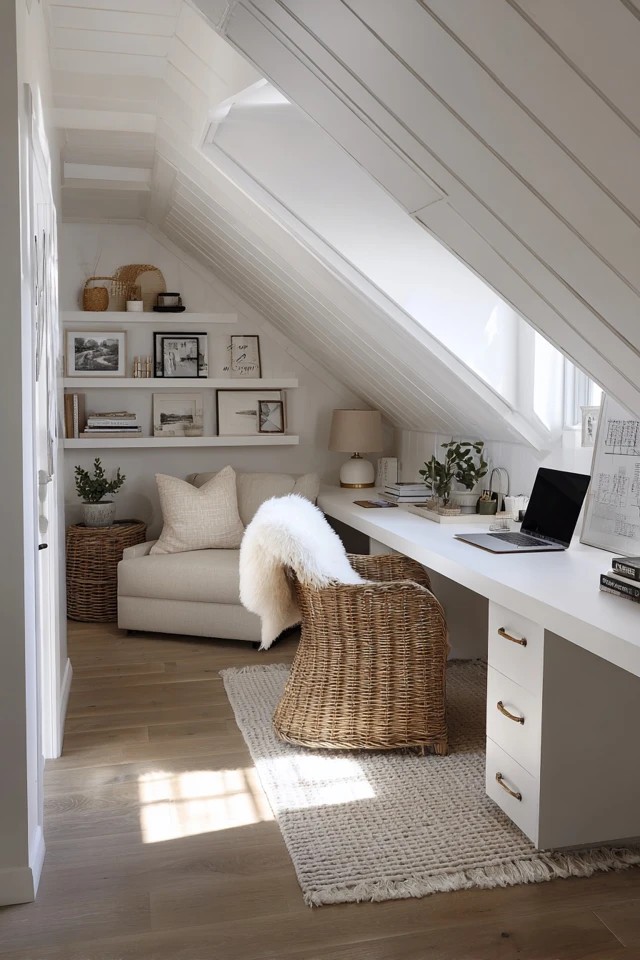
A comfortable armchair in a corner of the attic office creates a deliberately separate physical zone for the mental activities that do not happen well at a desk — reading long documents, thinking through problems, taking phone calls, or simply resting during a break. The change of posture and position from desk chair to armchair provides a genuine neural reset that improves overall productivity, and natural light from the adjacent dormer makes the corner as well-lit as the desk itself.
- Position the armchair to face a window or the room’s best architectural feature rather than the back of a wall.
- Include a small side table beside the chair for a notebook, phone, and coffee that support non-desk working sessions.
- Keep the chair at least 4 feet from the desk so the visual and psychological separation between work zones is meaningful.
13. Cable Management System for a Professional Clean Desk

A systematic cable management approach — under-desk cable trays, velcro bundling straps, labelled cable identifiers, and a single centralised power strip — transforms the technology-heavy desk from a tangle of visible cords into a clean, professional working surface.
- Run all desk cables through a single cable tray mounted beneath the desk surface and route to a concealed power strip below.
- Use velcro ties rather than zip ties for cable bundling — velcro allows reconfiguration without cutting and replacing ties.
- Label both ends of every cable at installation time so any cable can be identified and traced without following its length.
14. Biophilic Plant Styling for Stress Reduction and Air Quality

Houseplants on the desk and shelves introduce biophilic benefits — documented stress reduction, improved air quality, and the restorative cognitive effect of natural forms — into the working environment. The attic office’s abundant natural light supports genuinely thriving plants rather than the struggling, yellowing specimens that interior offices typically contain, making the biophilic investment particularly rewarding in this well-lit setting.
- Choose compact, non-fragrant species for the desk position — strong scents from proximity can cause headaches during long working sessions.
- Use a moisture meter rather than a schedule for watering — attic temperature variations change water requirements significantly week to week.
- Position the largest, most dramatic plant beside the dormer window as the office’s primary living design feature.
15. Area Rug for Acoustic Improvement and Zone Definition

An area rug placed beneath the desk and chair creates a defined work territory within the attic office while providing meaningful acoustic improvement — attic spaces with hard floors, sloped ceilings, and glass panels are inherently reverberant, and a rug of sufficient size absorbs the mid and high-frequency sound that creates the echo quality that undermines video call audio quality and focus concentration.
- Choose a low-pile or flatweave rug for under a desk chair — thick pile catches chair wheels and makes rolling difficult.
- Use a hard-floor chair mat on top of the rug for smooth rolling while maintaining the rug’s acoustic benefit beneath.
- Extend the rug at least 24 inches beyond the desk on all active sides for full acoustic benefit in the work zone.
16. Dual Monitor Setup for Digital Workflow Efficiency

A dual monitor configuration significantly expands the effective digital workspace for multitasking, document comparison, research alongside writing, and any workflow that benefits from simultaneous visibility of multiple applications.
- Position both monitors perpendicular to any dormer or skylight window to prevent direct reflective glare on either screen.
- Set the top of both monitor screens at eye level when seated to maintain a neutral neck position throughout the working day.
- Use a single ultra-wide monitor as an alternative to two standard screens for a seamless continuous display without the centre bezel gap.
17. Inspirational Artwork and Vision Board for Daily Motivation

A carefully chosen piece of artwork or a curated vision board mounted in the direct sightline from the desk chair gives the attic office a personal motivational element that distinguishes it from a generic work setup.
- Mount the vision board or artwork at eye level from the seated desk position — standard wall hanging height is too high.
- Review and refresh the vision board content quarterly — habituated visual stimuli cease to register as motivational prompts over time.
- Choose artwork in a dominant colour that complements the office’s neutral palette without introducing a competing colour scheme.
18. Built-In Desk Along the Wall for Custom Spatial Integration

A built-in desk constructed along a specific wall section — fitted precisely beneath the slope, with integrated drawers on one side and open shelving on the other — creates the most spatially efficient and architecturally resolved workspace available in an attic office.
- Build the desk surface at 74-76cm — standard desk height — regardless of slope height above, with the cabinetry depth adjusted to suit.
- Include at least two drawers within arm’s reach of the primary seated position for frequently accessed everyday items.
- Use the same joinery for the built-in desk and the knee wall shelving for a cohesive, fully integrated office suite throughout the room.
19. Neutral Colour Palette for a Focused Calm Workspace

A palette of whites, warm beiges, and soft greys with natural wood accents creates the most cognitively supportive attic office environment — the neutral ground is restful enough to sustain focus across long working sessions without the visual fatigue that bold colour schemes cause over extended exposure.
- Use warm white on the ceiling and greige on the walls for the most sophisticated tonal variation within a neutral scheme.
- Introduce warmth through a wood desk, rattan storage, and a natural linen window treatment rather than through colour on the walls.
- Reserve any single bold accent — a deep green plant, a warm amber lamp — for one deliberate focal application in the space.
20. Printer Station on a Dedicated Side Surface

A dedicated printer station — whether a small side table, a rolling cart, or a built-in section of the knee wall cabinetry — keeps the primary desk surface entirely clear for active work by relocating the printer, paper stock, and associated supplies to a dedicated support surface.
- Position the printer station within a single chair-roll of the primary desk for comfortable retrieval without standing.
- Store paper reams on the shelf below the printer body so supplies and equipment remain co-located and easy to maintain.
- Connect the printer to the home network rather than using a USB cable so the printer station does not need to be physically adjacent to the desk.
Why These Attic Office Ideas Excel
Ergonomics — desk placement, the standing desk option, correct monitor positioning, and an adjustable task lamp — are non-negotiable foundations that no amount of inspiring architecture compensates for.
Storage and organisation — built-in knee wall shelving, floating shelves, a filing cabinet under the eave, and a dedicated printer station — is what determines whether the attic office remains functional over years of daily use.
Conclusion
An attic office, designed with attention to both the practical requirements of productive work and the distinctive architectural opportunities of the converted space, becomes a genuinely exceptional place to spend the working day. Position the desk for maximum headroom, build storage into every eave and knee wall, manage cables with deliberate organisation, and invest in ergonomic seating. The attic office is not a compromise — it is an upgrade.

Andrew is the founder and lead writer at RoomBlossom, a home decor publication dedicated to practical, intentional interior design. With over 10 years of hands-on experience transforming real-world living spaces — from compact apartments to full attic conversions — Andrew specialises in room design that balances visual appeal with everyday function. His work spans living rooms, bedrooms, sunrooms, and attic spaces, always guided by the belief that great design should work for the people who live in it, not just look good in photographs.