
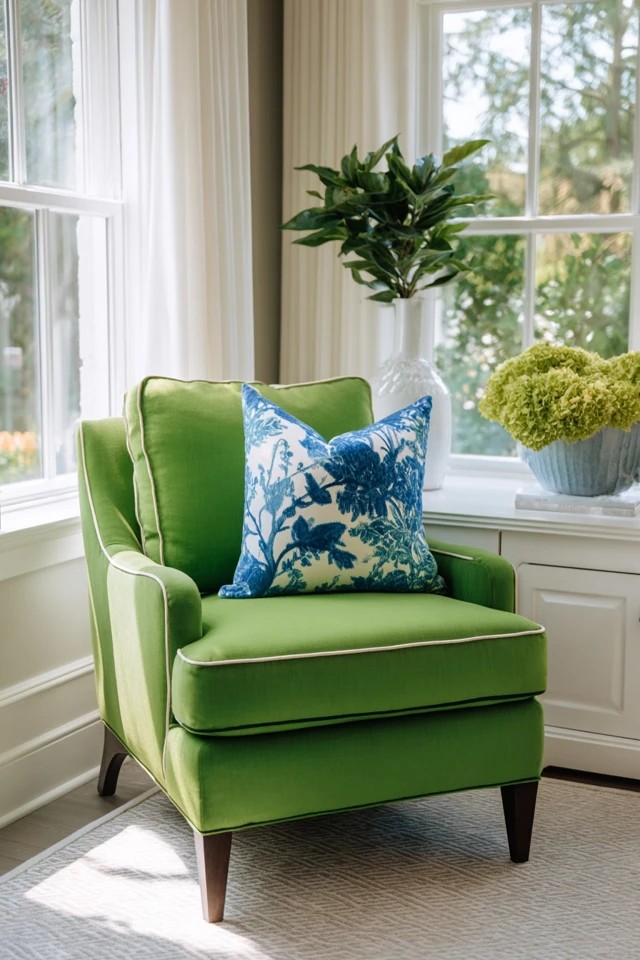
Green is the colour of nature, growth, and the living world beyond the sunroom’s glass walls — which makes it the most natural and resonant colour choice for a space defined by its connection to the outdoors. From pale mint to deep forest, from earthy olive to vivid Kelly, the green family offers more variety and design possibility than almost any other colour on the spectrum.
Here are 20 green sunroom ideas spanning painted walls, botanical wallpaper, velvet cushions, accent furniture, and layered green palettes — each one demonstrating a different way to bring green’s botanical energy into a light-filled sunroom.
1. Sage Green Walls for a Calming Nature-Inspired Backdrop
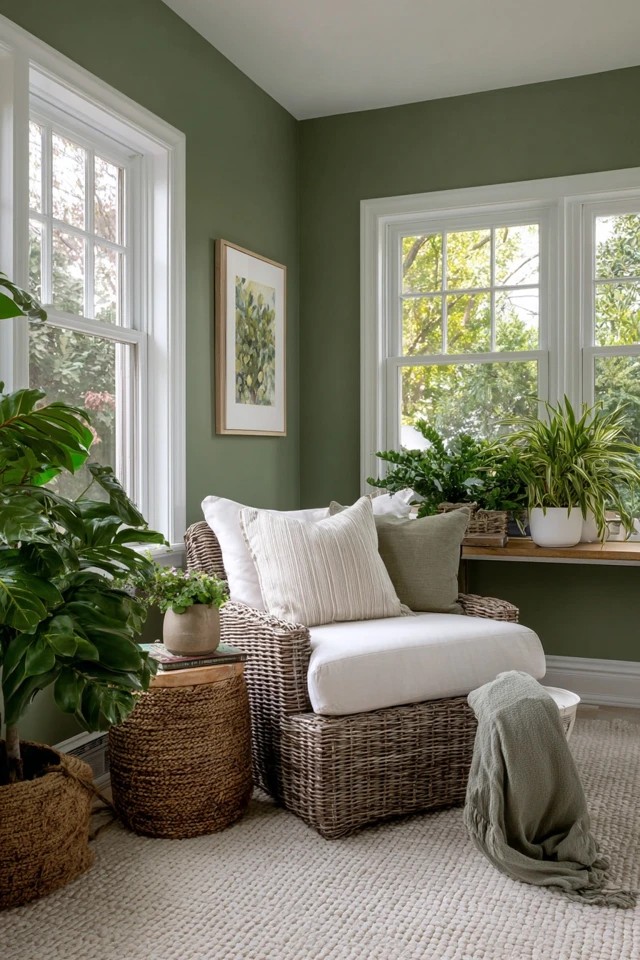
Sage green walls — the soft grey-green of dried herbs and frosted eucalyptus — create a sunroom backdrop of remarkable tranquility. White or natural linen furniture keeps the palette airy and prevents the green from feeling enclosed.
- Test sage paint samples at different times of day — the colour shifts significantly between morning and afternoon light.
- Choose a flat or eggshell finish for sage walls to prevent sunroom light from creating distracting reflections.
- Pair sage walls with warm wood floors and white trim for the most classic, balanced sage sunroom palette.
2. Emerald Green Velvet Cushions for Jewel-Tone Luxury

Emerald green velvet cushions on white or cream seating create one of interior design’s most reliably striking colour combinations — the saturated jewel tone pops vividly against the neutral ground, and the velvet’s pile catches sunroom light in shifting highlights and shadows that make the green appear to change depth as you move around the room.
- Choose velvet cushions in a genuine emerald — not too blue, not too yellow — for maximum jewel impact.
- Limit emerald velvet to cushions and throws rather than large upholstered pieces to keep it as an accent.
- Pair emerald with brass or gold hardware and accessories for a glamorous, richly layered green palette.
3. Forest Green Accent Wall for Bold Nature Drama

A single forest green feature wall — deep, saturated, commanding — creates a sunroom focal point with genuine woodland drama. The dark tone recedes visually, making the wall appear further away and the room feel larger in the opposite direction.
- Apply the forest green to the wall directly opposite the primary entrance for maximum visual impact on arrival.
- Choose a matte finish for the accent wall — it absorbs light rather than reflecting it, deepening the colour.
- Use warm brass fixtures and natural wood furniture to balance the coolness of deep forest green.
4. Olive Green Painted Furniture for Earthy Vintage Charm

Olive green painted furniture — chairs, a side table, or a console — brings a muted, organic quality to the sunroom that wall colour alone cannot achieve.
- Use chalk paint for furniture pieces to achieve the flat, velvety olive finish that captures the vintage quality.
- Seal chalk-painted furniture with a matte wax finish to protect the surface without adding unwanted sheen.
- Mix olive-painted pieces with unpainted natural wood items to prevent the green from dominating the room.
5. Mint Green Ceiling for Playful Architectural Surprise

A mint green ceiling introduces colour from the one direction most people never think to look, creating a playful architectural surprise that makes the sunroom feel genuinely distinctive and personal.
- Use a very pale mint — barely-there green — so the ceiling reads as a whisper of colour rather than an overwhelming statement.
- Keep all four walls white or very pale cream so the mint ceiling remains the sole colour element overhead.
- Extend the mint to the window frames for a cohesive, cottage-inspired architectural colour scheme.
6. Botanical Green Wallpaper for an Immersive Garden Feature

Botanical wallpaper in a leaf, fern, or tropical print brings the garden indoors in the most literal way — surrounding the sunroom occupant with enlarged, stylised versions of the foliage visible through the glass outside.
- Use botanical wallpaper on a single feature wall rather than all four to avoid a visually overwhelming result.
- Choose a wallpaper with a white or pale background to keep the sunroom feeling light and airy rather than heavy.
- Complement the wallpaper with real plants nearby so the printed and living foliage create a layered dialogue.
7. Kelly Green Accent Chair for a Vibrant Colour Statement

A Kelly green armchair — true, saturated, unambiguously green — creates the kind of bold single-colour statement that interior designers describe as a “hero piece.” Against white walls and natural wood flooring, the chair’s vivid hue commands the room’s attention without requiring any supporting cast.
- Choose a simple, classic chair silhouette so the colour rather than the shape carries the visual weight.
- Upholster in a performance fabric to handle sunroom UV exposure without fading over the first few years.
- Keep everything else in the room neutral — the Kelly chair works best as the sole colour statement.
8. Moss Green Velvet Curtains for Textured Window Luxury

Floor-length moss green velvet curtains bring an unexpected luxury to the sunroom — the pile of the velvet shifts between deep forest and bright olive as natural light falls across it from different angles throughout the day.
- Choose velvet curtains with a weighted hem tape to ensure they hang in straight, clean folds to the floor.
- Install the curtain rod close to the ceiling and wide beyond the window frame for maximum drama.
- Line the curtains with an interlining layer to add body and prevent the velvet from appearing flat.
9. Hunter Green Wainscoting for Traditional Architectural Elegance

Hunter green wainscoting on the lower walls with white paint above is one of traditional interior design’s most enduring and satisfying compositions — the dark lower register grounds the room with weight and richness while the white upper walls keep the sunroom bright and open.
- Paint the wainscoting cap rail white to create a clear, clean division between the two tones.
- Choose a satin finish for the hunter green wainscoting for easier cleaning and slight reflective quality.
- Maintain the wainscoting height at one-third of the total wall height for correct traditional proportion.
10. Teal Green Rug for Coastal Blue-Green Grounding
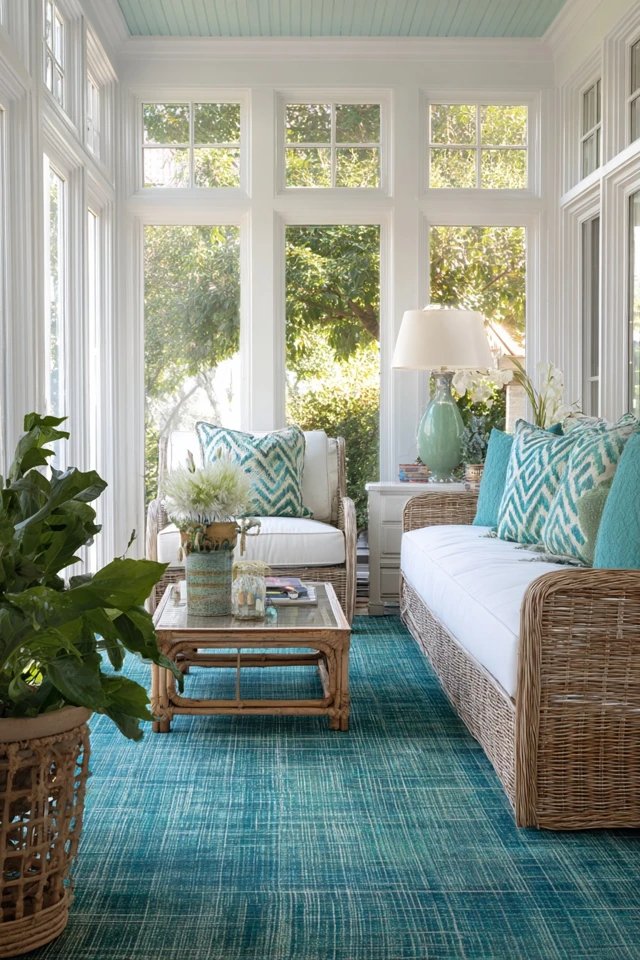
A teal rug occupies the fascinating territory where green and blue meet — evoking shallow tropical water, aged copper, and the colour of sea glass collected from a favourite beach.
- Choose a teal that reads more green than blue in the room’s specific natural light before committing.
- Use a teal rug with a simple flatweave or low pile to let the colour be the primary interest rather than the texture.
- Repeat small doses of the teal tone in cushions or a single accessory to connect the rug to the room above it.
11. Pistachio Green Door for Charming Architectural Accent

A pistachio green door — pale, creamy, gently yellow-green — transforms an architectural necessity into a charming design feature that welcomes visitors into the sunroom with a soft smile of colour.
- Choose a satin or semi-gloss finish for the door so it reads distinctly from the surrounding flat walls.
- Extend the pistachio colour to nearby window shutters or flower boxes for a cohesive cottage architectural scheme.
- Add simple brass hardware — lever handle and hinges — to complement the pistachio’s warm yellow undertone.
12. Chartreuse Artwork for Contemporary Yellow-Green Energy

A large piece of chartreuse artwork — the electric yellow-green that sits at the most energetic point of the colour spectrum — creates a contemporary focal point with genuine visual power. This is a colour for bold, confident design decisions.
- Use chartreuse as artwork only — this intensity works as a focal accent, not as wall colour or upholstery.
- Frame chartreuse art simply in black or natural oak to contain and focus its visual intensity.
- Position chartreuse artwork opposite the primary window so natural light falls directly on the canvas face.
13. Jade Green Accent Pillows for Balanced Mid-Tone Colour

Jade green cushions occupy the comfortable middle ground between the paleness of mint and the intensity of emerald — a balanced, gemstone saturation that adds genuine colour without overwhelming a neutral base.
- Group jade pillows in pairs on a sofa or loveseat for a symmetrical, balanced accent placement.
- Combine jade with warm terracotta or burnt orange accessories for a complementary colour pairing with natural resonance.
- Choose jade in a linen or cotton weave rather than velvet for a more casual, everyday sunroom aesthetic.
14. Bottle Green Cabinets for Dark Sophisticated Storage

Bottle green built-in cabinets or storage units — with their deep, near-black green and complementary brass hardware — create a statement of serious design sophistication in the sunroom.
- Choose brass or unlacquered bronze hardware that will develop a natural patina to complement the bottle green.
- Use bottle green on storage cabinetry only — not on open shelving where the dark colour would swallow book spines.
- Pair bottle green cabinets with pale warm wood floors to prevent the combination from feeling heavy and cold.
15. Seafoam Green Walls for Soft Coastal Aqua Atmosphere
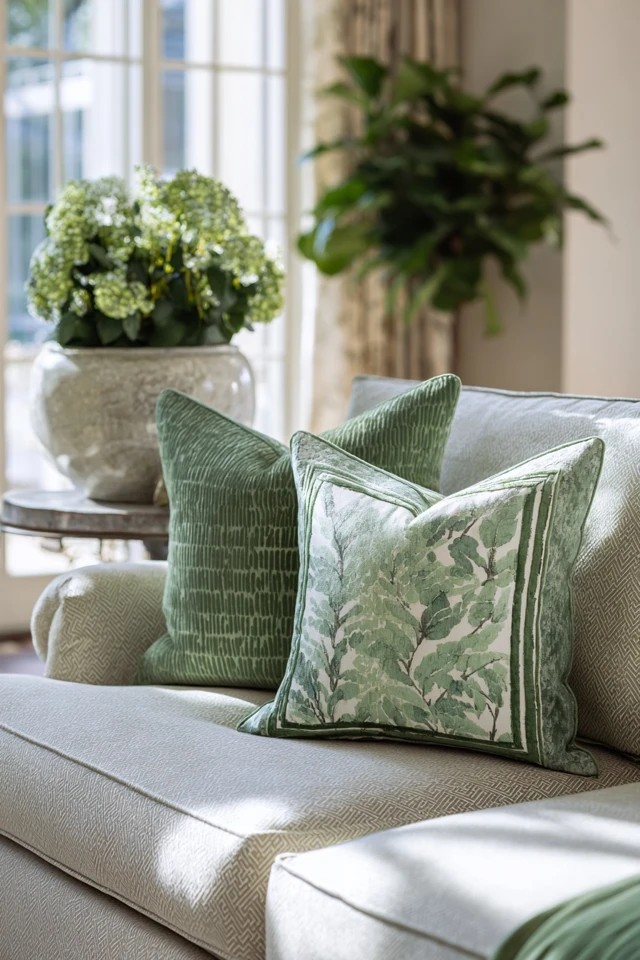
Seafoam green walls — pale, watery, evocative of sea glass and shallow tropical shallows — create a coastal sunroom atmosphere of genuine softness and calm.
- Choose a seafoam with more blue than yellow undertone for the most genuinely aquatic, coastal quality.
- Pair seafoam walls with white furniture and natural rattan accessories for authentic coastal sunroom style.
- Add white sheer curtains to seafoam walls — the combination in natural sunroom light is luminously beautiful.
16. Eucalyptus Green Textiles for Sophisticated Grey-Green Layering

Eucalyptus green textiles — dusty, grey-tinged, botanical — bring a sophisticated restraint to the sunroom palette that bolder greens cannot achieve.
- Layer eucalyptus with sage and soft white for a fully tonal green palette of remarkable refinement.
- Choose eucalyptus in woven, textured fabrics — linen, cotton gauze, loose knit — for the most botanical feeling.
- Add actual eucalyptus stems in a vase nearby to connect the textile colour to its living botanical source.
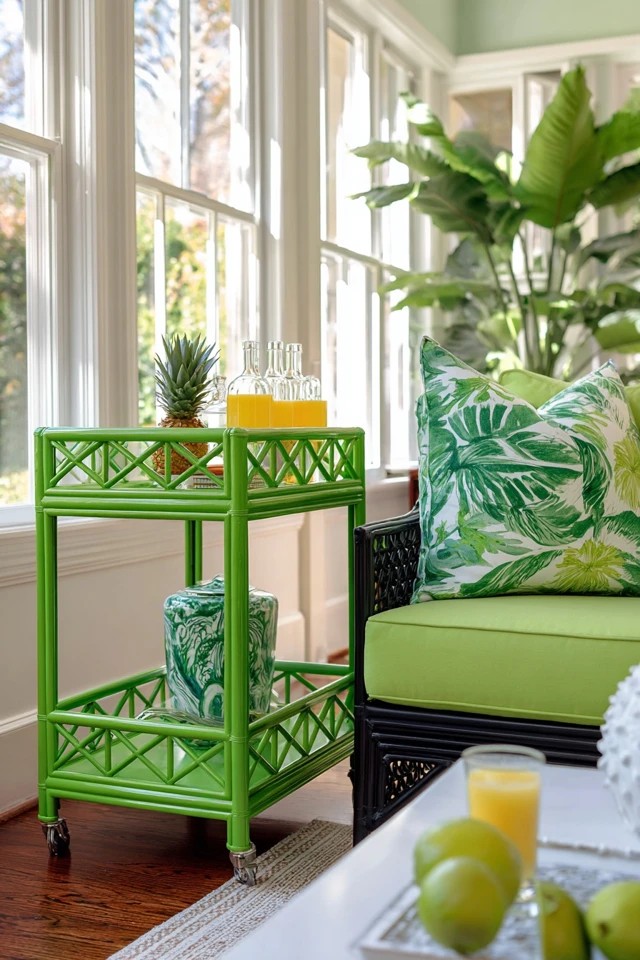
17. Lime Green Bar Cart for Playful Contemporary Accent

A lime green bar cart introduces a shot of citrus energy that is both functional and joyfully decorative — the vivid yellow-green is unexpected, cheerful, and entirely at home in a sunroom where bright natural light already sets an energetic mood.
- Choose a powder-coated metal cart for the most durable lime finish that resists sunroom UV fading.
- Style the cart with clear glass and brass accessories to let the lime cart colour remain the primary statement.
- Position the lime cart against a white wall where the colour contrast is maximised and uncompromised.
18. Ombré Green Gradient Wall for Artistic Colour Drama
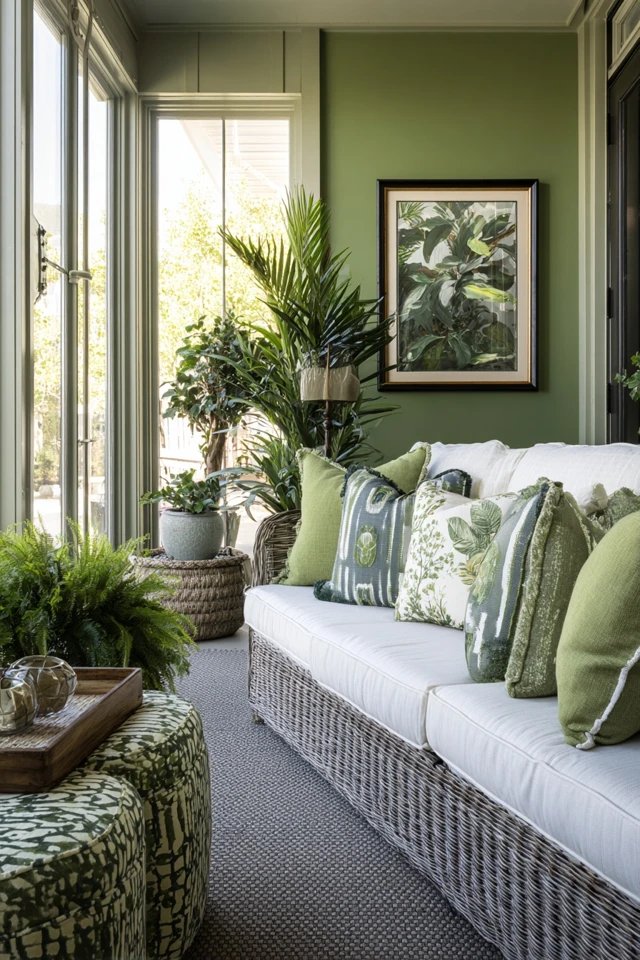
An ombré wall that transitions from pale sage at the ceiling to deep forest at the floor creates a dramatic, artistic backdrop that changes in character as natural sunroom light moves across it throughout the day.
- Use two or three intermediate tones between the lightest and darkest shades for a smooth, gradual transition.
- Blend each colour boundary while the paint is still wet using a dry brush in circular feathering motions.
- Reserve the ombré technique for a single wall — applying it to all four walls would be visually overwhelming.
19. Apple Green Bench or Ottoman for Fresh Bright Seating
An apple green bench or ottoman — the fresh, yellow-toned green of a Granny Smith apple — brings a burst of cheerful fruit-like energy to the sunroom that feels genuinely joyful rather than merely decorative.
- Choose a simple bench or cube ottoman shape so the colour reads clearly without competing forms.
- Upholster in a performance velvet or coated fabric for durability in the high-UV sunroom environment.
- Limit apple green to one piece of seating — more than one and the energy becomes excessive rather than cheerful.
20. Mixed Green Tones from Sage to Emerald for a Layered Botanical Palette

Layering multiple green tones — pale sage walls, jade cushions, emerald throw, olive accessories, and a forest green plant pot — creates a sunroom palette of genuine botanical complexity and richness.
- Vary the green tones by both value (light to dark) and undertone (yellow-green to blue-green) for maximum richness.
- Ground the multi-green palette with a consistent neutral — white walls, natural wood floors — to prevent it from reading as chaotic.
- Use the lightest green on the largest surfaces and reserve the deepest, most saturated tones for small accents.
Why These Green Sunroom Ideas Excel
Every idea on this list succeeds because green is the colour most naturally suited to the sunroom environment — it is the dominant colour of the outdoor world visible through the glass, and introducing it into the interior creates a seamless visual continuity between inside and outside that no other colour achieves as naturally. Green sunroom design is essentially biophilic design in its most direct and accessible form.
The variety of the green family is what makes it so versatile for sunroom design. Pale sage and seafoam create calm, tranquil environments; deep forest and bottle green add drama and sophistication; emerald and Kelly deliver energetic colour statements; olive and eucalyptus bring organic earthiness. No single other colour offers this range from serene to vivid, warm to cool, sophisticated to playful within a single family.
Green and natural light have a special relationship in the sunroom context. Natural daylight enhances green’s botanical resonance, shifting its apparent tone from hour to hour — cooler in morning light, warmer in afternoon sun, deeper on overcast days. This dynamic quality makes green one of the most rewarding colours to live with in a light-rich environment, offering a subtly different visual experience throughout the day.
Green as accent versus green as backdrop are two fundamentally different design strategies, and this list demonstrates both. Single-colour accent approaches — the Kelly chair, the emerald cushions, the chartreuse artwork — use green as a high-impact focal statement against neutral surroundings. Backdrop approaches — sage walls, botanical wallpaper, the ombré gradient — use green to create an immersive environment where the colour becomes the room’s defining atmosphere rather than its focal point.
Conclusion
Green is the sunroom’s most natural colour partner — the shade of the living world beyond the glass, the colour of growth, freshness, and the botanical world that sunroom design celebrates. Whether you choose one perfect Kelly green chair as a single bold statement or layer multiple green tones from sage to emerald across walls, textiles, and accessories, the ideas in this article provide a complete toolkit for creating a green sunroom that feels both beautifully designed and genuinely alive.

Andrew is the founder and lead writer at RoomBlossom, a home decor publication dedicated to practical, intentional interior design. With over 10 years of hands-on experience transforming real-world living spaces — from compact apartments to full attic conversions — Andrew specialises in room design that balances visual appeal with everyday function. His work spans living rooms, bedrooms, sunrooms, and attic spaces, always guided by the belief that great design should work for the people who live in it, not just look good in photographs.