
Attic organisation is the difference between a household that runs smoothly and one that dreads every trip up the pull-down stairs to retrieve a single Christmas decoration buried beneath years of accumulated chaos. A properly organised attic functions as the home’s most valuable secondary storage system — an accessible, logical archive of seasonal items, keepsakes, documents, and household overflow that can be navigated in minutes rather than hours.
Here are 20 attic organisation ideas spanning labeled bin systems, zone-based layouts, climate control, built-in shelving, and inventory tracking — each one demonstrating how to transform an underutilised roof space into a genuinely functional, efficiently managed storage environment.
1. Labeled Storage Bins for Systematic Identification
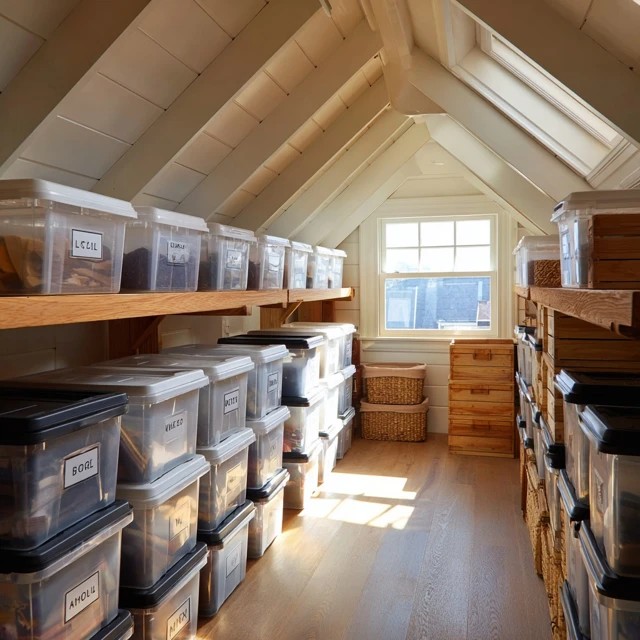
A system of clear plastic bins with large, consistently applied labels creates the foundation of any well-organised attic — when every container is identifiable without opening it, retrieval becomes a matter of seconds rather than a rummage through multiple unmarked boxes.
- Use a label maker rather than handwriting for consistent, professional labels that remain legible over many years.
- Apply labels on the lid and one side of every bin so contents are identifiable from multiple angles when stacked.
- Review and update labels whenever bin contents change — an inaccurate label is worse than no label.
2. Built-In Shelving Along the Knee Walls for Custom Storage
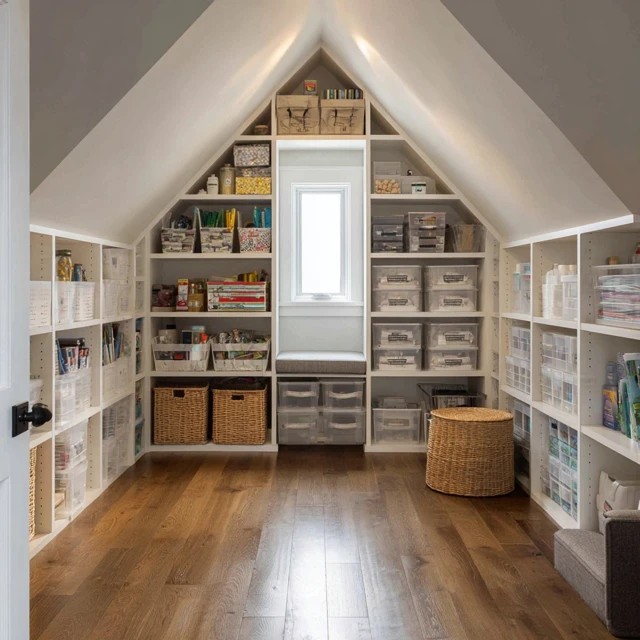
Custom shelving built along the knee walls — the short vertical sections between the floor and the beginning of the roof slope — creates organised storage that uses the attic’s most accessible and practical zones for the most frequently needed items. Floor-to-ceiling shelves in these sections hold labelled bins and boxes in clear categorical rows,
- Build shelf depths at 40-45cm to accommodate standard storage bins without bins overhanging the shelf edge.
- Install adjustable shelf pins rather than fixed shelves to reconfigure spacing as stored item heights change over time.
- Leave at least 90cm of clear aisle space in front of shelves for comfortable access and safe item retrieval.
3. Zone-Based Layout for Categorical Sorting
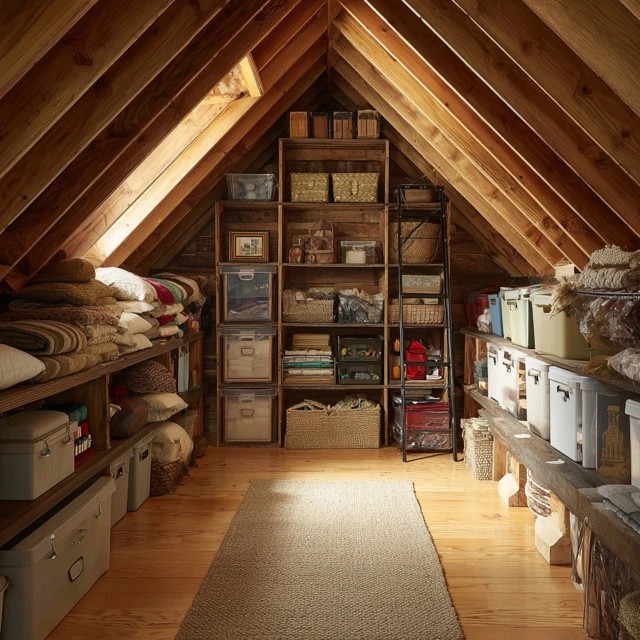
Dividing the attic floor plan into clearly defined zones — one for holiday decorations, one for seasonal clothing, one for sports equipment, one for family keepsakes, one for household documents — creates an organisation system that is navigable on the basis of category rather than individual item knowledge.
- Map the zone layout on paper before implementing — assign the most-accessed zones (seasonal, holiday) to the area nearest the attic access point.
- Mark zone boundaries with coloured floor tape that remains visible even when items are stored on the floor within each zone.
- Review the zone layout annually and adjust zone sizes as category volumes expand or contract over time.
4. Metal Shelving Units for Heavy-Duty Load Bearing
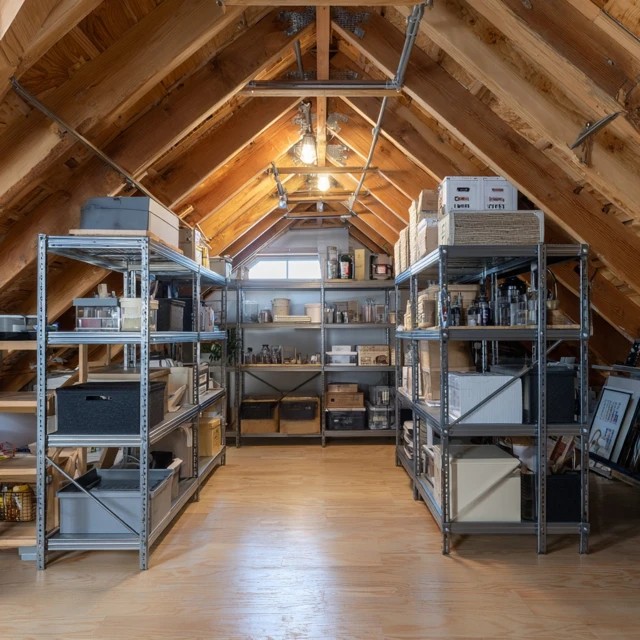
Adjustable steel shelving units deliver the structural strength required for storing the heaviest attic items — archive boxes, paint tins, tools, and bulk purchases — that would overload lightweight shelving over time. The adjustable shelf heights accommodate containers of varying sizes without wasted vertical space,
- Choose shelving with a minimum 150kg per shelf rating for safe storage of heavy boxed and packaged items.
- Anchor freestanding metal shelving units to a wall stud or the structural roof members to prevent tipping when heavily loaded.
- Apply rubber shelf liner to prevent stored items from sliding and scratching the metal surface during retrieval.
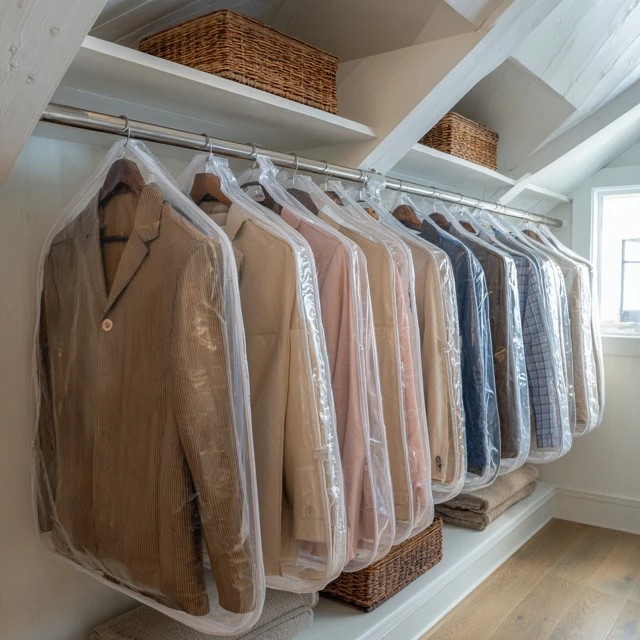
5. Hanging Garment Bags for Seasonal Clothing Protection
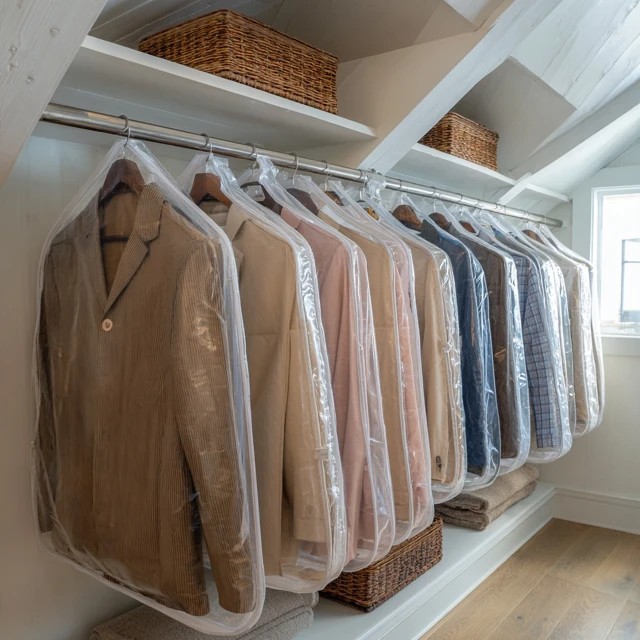
Zippered garment bags hung on a dedicated rod in the attic protect off-season clothing from the dust accumulation, moth damage, and UV fading that open storage or standard box folding allows. The hanging format keeps structured garments — coats, suits, dresses — wrinkle-free throughout the months of storage, and
- Store garments clean before hanging — food and perspiration residues are the primary moth attractant in stored clothing.
- Use cedar blocks or lavender sachets inside each garment bag as a natural, non-chemical moth deterrent.
- Label each garment bag on its hanger hook with a tag identifying contents and the season for which they should be retrieved.
6. Rolling Cart for Mobile Ergonomic Access
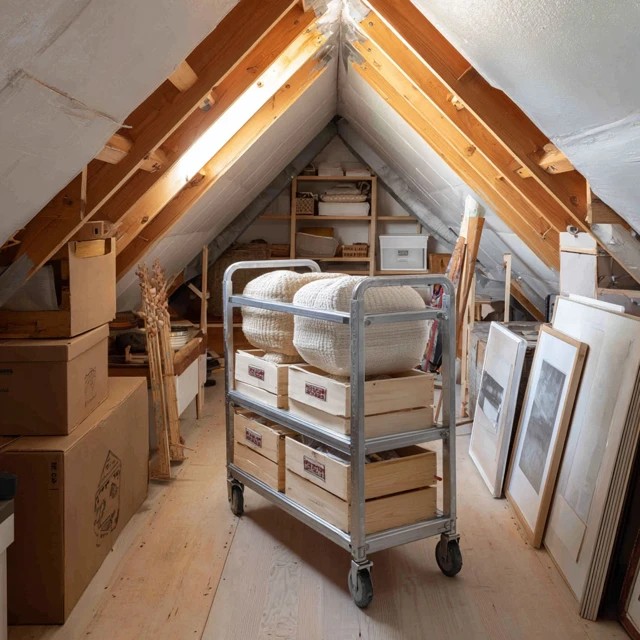
A rolling cart on locking casters provides the most ergonomically efficient way to move items around the attic during packing and unpacking sessions — the cart travels to wherever items are stored, loads are transferred to the cart rather than carried by hand across the attic floor, and the loaded cart is then rolled to the access stairs rather than requiring multiple carrying trips.
- Choose a cart with locking casters so it stays fixed at each stop during loading without rolling away.
- Select a cart narrow enough to fit through the attic access hatch — typically 45cm wide maximum.
- Use the cart’s lower shelf for the heaviest items and the upper surface for lighter objects during each trip.
7. Colour-Coded Container System for Visual Categorisation
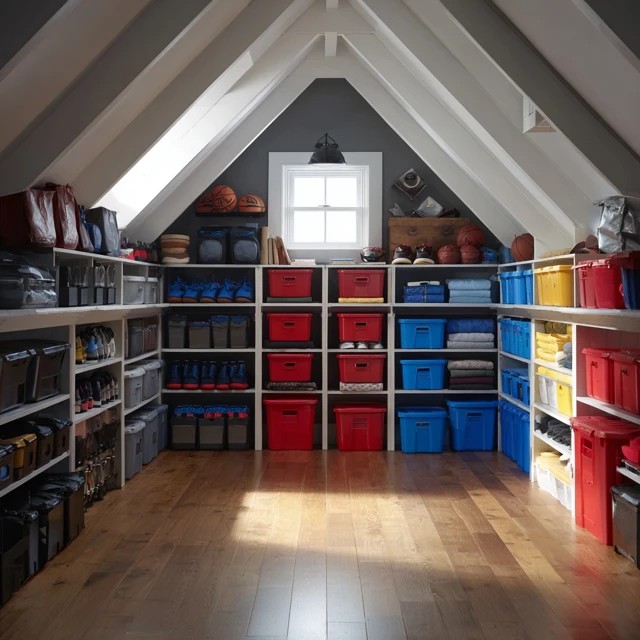
Assigning each storage category a specific bin colour — red for Christmas, orange for Halloween, blue for sports, green for gardening, yellow for summer — creates a visual categorisation system that allows correct zone identification from across the attic without reading any label.
- Document the colour-to-category assignment and post it at the attic access point so the system is self-explanatory to all users.
- Choose a single bin brand and colour range so all bins within each category have identical dimensions for stacking compatibility.
- Assign the most-accessed categories to the most distinct, easily remembered colours for the fastest daily identification.
8. Wall Hooks for Vertical Hanging Storage
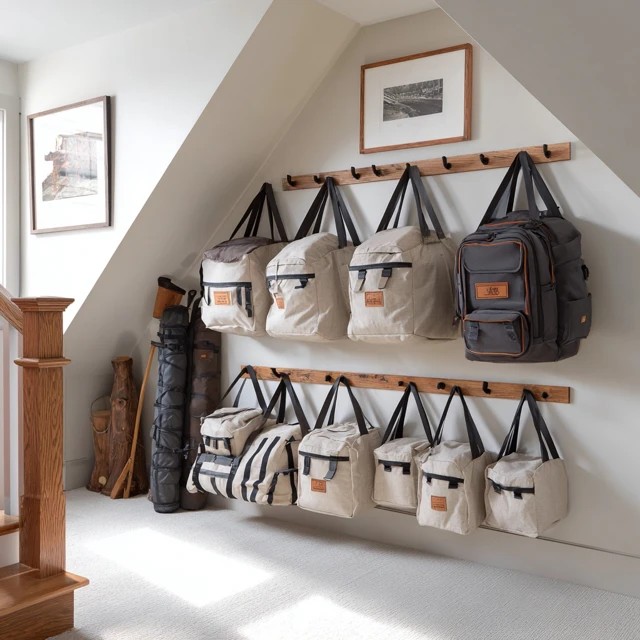
Heavy-duty hooks mounted on the attic’s structural wall sections hold seasonal equipment, sports bags, camping gear, and large accessories without consuming any floor space — the items hang clear of the floor while remaining immediately accessible and fully visible.
- Use masonry or stud-mounted hooks rated for the combined weight of the heaviest items they will hold — typically 25-50kg per hook.
- Group hooks by category — all sports equipment together, all camping gear together — for logical organised hanging.
- Install hooks at two different heights to accommodate items of different lengths without the longest items touching those below.
9. Posted Inventory List for Content Tracking
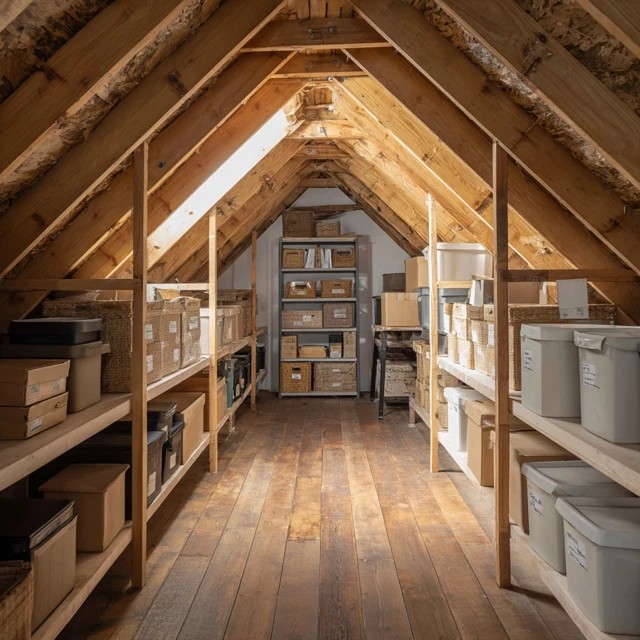
A master inventory list — whether a physical document posted at the attic entry point or a shared digital spreadsheet accessible from a phone — tracks every stored item by category, container number, and zone location, making the entire attic’s contents retrievable without a physical search.
- Update the inventory list every time an item is added, removed, or relocated within the attic organisation system.
- Use a shared cloud-based spreadsheet so all household members can access the inventory from any location without entering the attic.
- Photograph the contents of each bin before sealing it so the inventory entry can reference a visual as well as a text description.
10. Vacuum-Sealed Bags for Space-Saving Compression
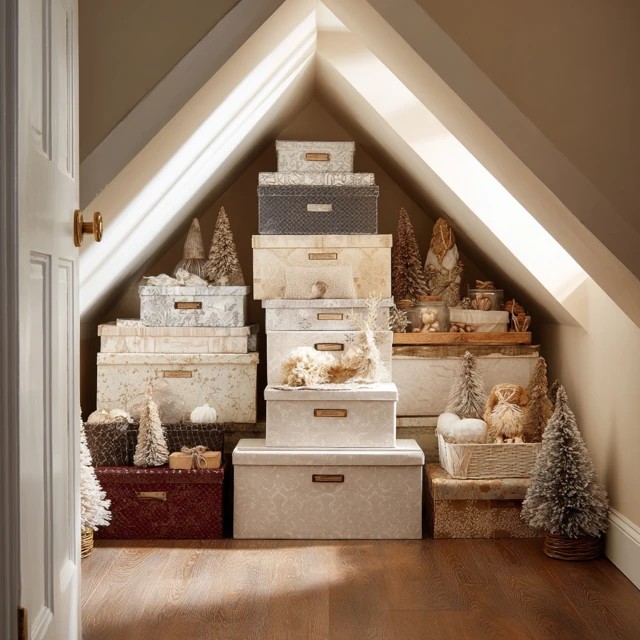
Vacuum-sealed storage bags reduce bulky duvets, pillows, sleeping bags, and thick winter clothing to a fraction of their uncompressed volume, dramatically increasing the effective storage capacity of shelves and bins that would otherwise be consumed by a single duvet.
- Use a cylinder vacuum with a suction attachment for the most complete air removal from storage bags.
- Store vacuum-sealed bags flat in stacked bins rather than on edge — vertical storage can rupture the seal over time.
- Re-seal and re-vacuum bags annually to compensate for the gradual air re-entry that occurs through the valve over time.
11. Pegboard Wall System for Customisable Organisation
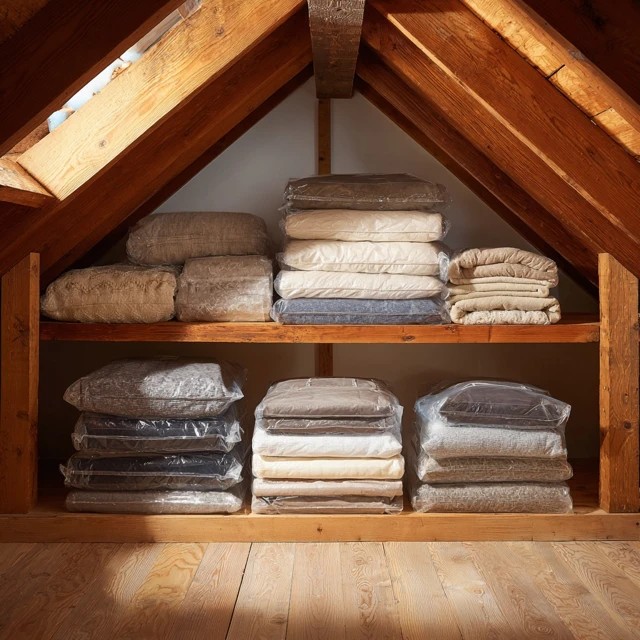
A pegboard panel on the attic wall creates a fully customisable organisation surface where hooks, bins, and shelves can be repositioned at any time as storage needs change — a practical advantage in an attic whose contents evolve significantly from year to year.
- Mount pegboard at least 2.5cm from the wall surface using spacers so hook tails have full engagement depth behind the board.
- Trace each hook and accessory position on the board with a marker before removal so the layout can be replicated after cleaning.
- Choose 6mm pegboard thickness for general storage — thinner boards flex under load and hooks become unreliable.
12. Holiday Decoration Boxes for Seasonal Celebration Storage
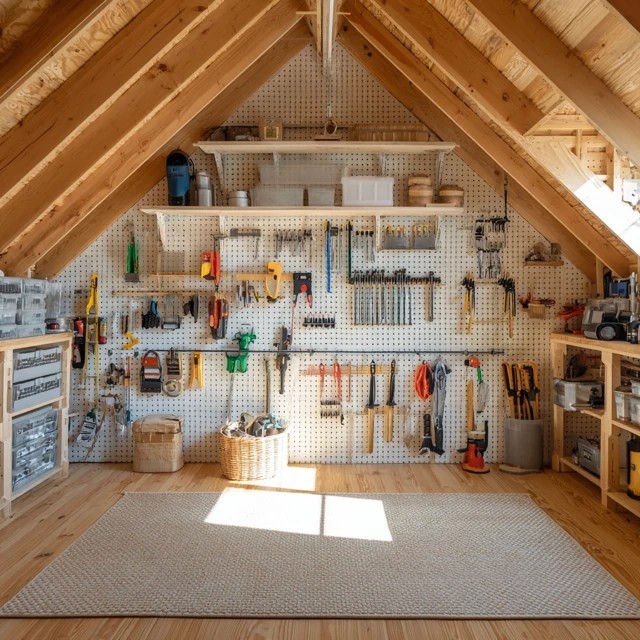
Dedicated boxes for each holiday’s decorations — labelled clearly and stored in the holiday zone with each year’s retrieval and return being a straightforward single-trip process — make festive decorating preparation effortless rather than dreaded.
- Label boxes with the holiday name in large text and include a brief contents list on a secondary smaller label.
- Store fragile ornaments in individual compartment boxes within the larger decoration bin to prevent breakage during annual retrieval.
- Include a small inventory sheet inside each holiday box listing what should be present when the box is returned after each season.
13. Pull-Down Attic Stairs for Safe Efficient Access
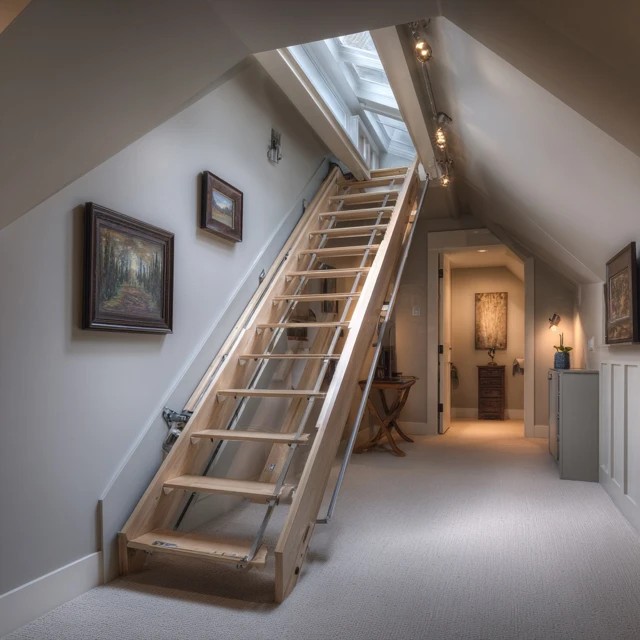
A spring-loaded pull-down stair system is the infrastructure investment that makes all other attic organisation efforts worthwhile — without safe, easy access that allows both hands to be free for carrying, even the most perfectly organised attic becomes difficult to use in practice.
- Choose a pull-down stair rated for at least 150kg — the weight of a person plus the items being carried simultaneously.
- Install handrails on both sides of the pull-down stair for safe single-handed descent when carrying items down.
- Add an insulated hatch cover above the stair opening to prevent significant heat loss from the main house in colder months.
14. Modular Cube Storage for Flexible Configuration
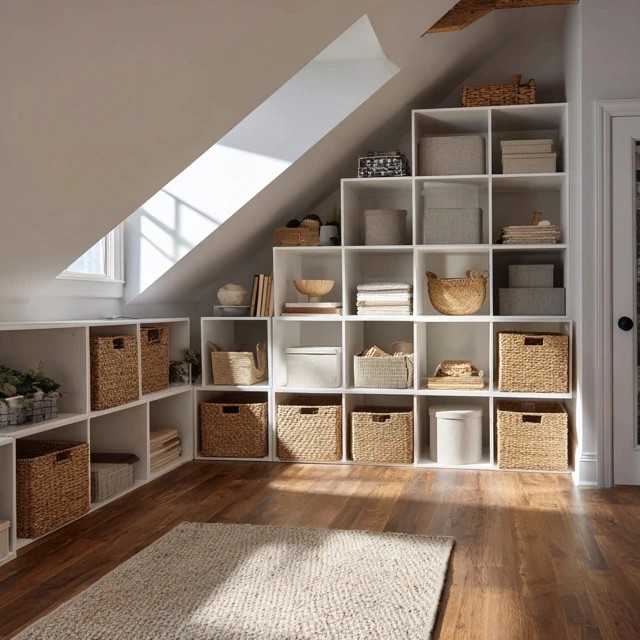
Modular cube units — stackable, connectable, and reconfigurable as storage needs evolve — provide attic organisation with the adaptability that fixed shelving systems cannot offer. The cubes can be assembled in any arrangement that suits the attic’s floor plan and current storage volume, and they can be expanded or contracted by adding or removing units without any structural commitment.
- Choose cube units that connect securely to adjacent units both horizontally and vertically to prevent collapse when heavily loaded.
- Use fabric drawer inserts in the cubes housing items that would look untidy through an open cube front.
- Reserve the top cube in each column for lightweight seasonal items accessed rarely — avoid placing heavy items at the top where they create instability.
15. Archival Document Boxes for Vital Record Preservation
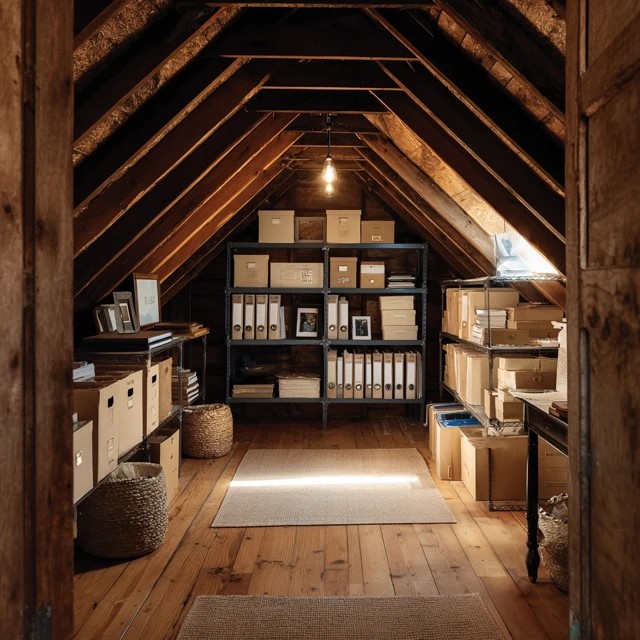
Acid-free archival boxes for important documents — property deeds, tax records, family photographs, legal papers, and identity documents — provide the long-term preservation that standard cardboard boxes actively undermine through acid migration over time.
- Choose boxes specifically labelled acid-free and lignin-free — standard cardboard accelerates document degradation through chemical transfer.
- Position archival document storage away from the roof peak where temperature extremes are most severe in both winter and summer.
- Create a master document index listing every box’s contents so records can be located without opening multiple boxes.
16. Overhead Pulley System for Elevated Ceiling Storage
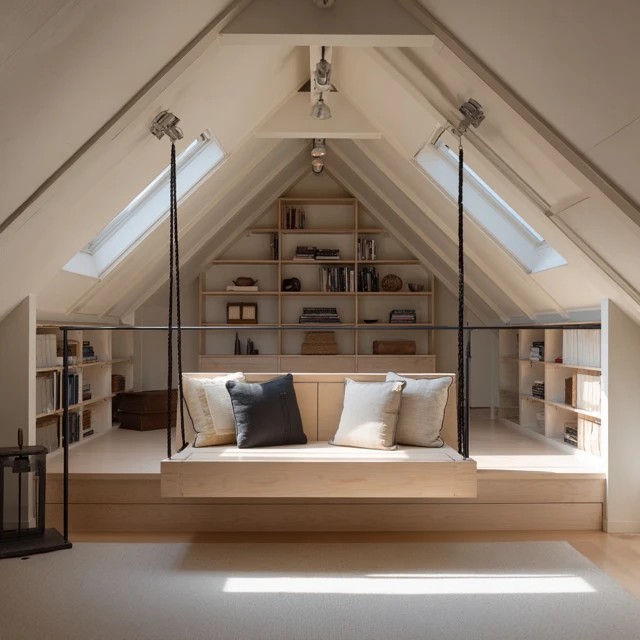
A pulley-operated storage platform suspended from the attic’s structural ceiling joists uses the overhead vertical dimension for items that are bulky, lightweight, and needed only once or twice per year — camping equipment, inflatable items, seasonal sporting goods.
- Ensure ceiling joists can safely support the combined weight of the platform and its maximum intended load before installation.
- Install a locking mechanism on the pulley so the raised platform cannot accidentally descend when not in use.
- Fit side rails on the elevated platform to prevent stored items from sliding off during the raising and lowering process.
17. Dehumidifier and Climate Control for Preservation
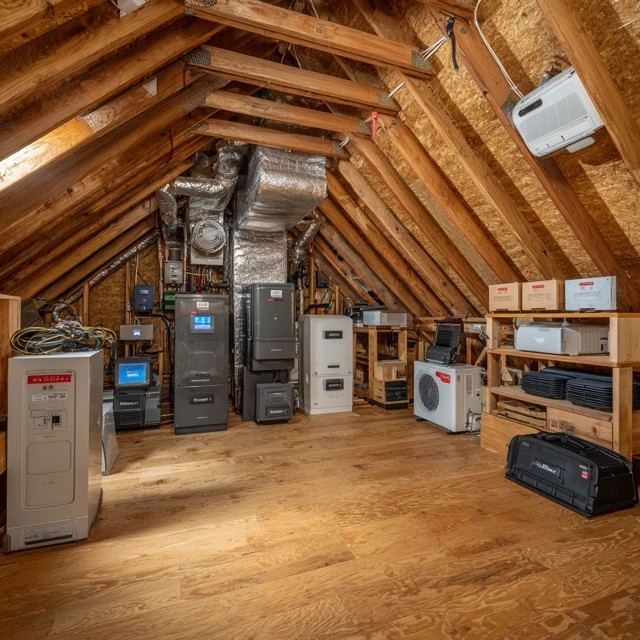
A dehumidifier running during humid summer months — or a ventilation fan creating consistent air circulation throughout the year — maintains the moisture level required to prevent mould, mildew, and insect activity in stored items.
- Set the dehumidifier to maintain relative humidity between 45-55% year-round for optimal preservation conditions.
- Choose a unit with an automatic continuous drainage connection rather than a manual collection tank for unattended operation.
- Install a basic humidity monitor in the attic so current conditions can be verified before storing sensitive items.
18. Clear Pathways Between Storage Zones for Safe Navigation
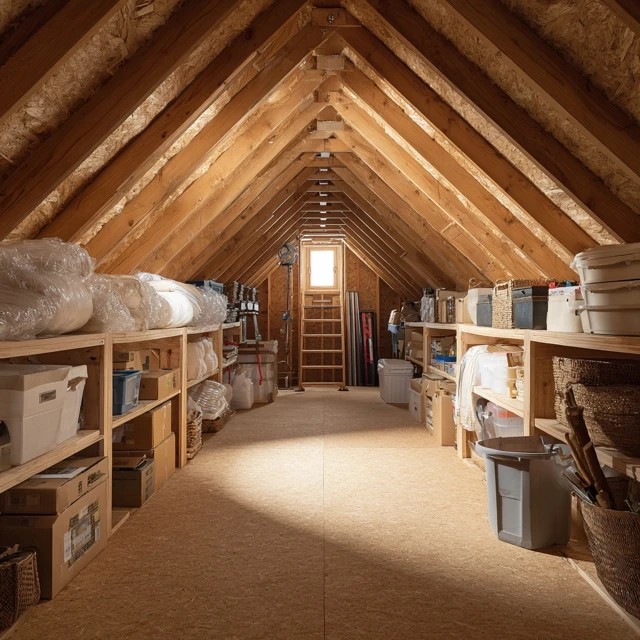
Maintaining walkable aisles of at least 70cm between storage zones and shelving runs is the safety and practical efficiency requirement that most overfilled attics sacrifice first — and whose absence makes the rest of the organisation system fail in practice.
- Mark aisle boundaries with floor tape before filling the attic so the pathway requirement is built into the layout from the start.
- Review and restore clear pathways at every seasonal attic session — gradual encroachment is the most common cause of aisle loss.
- Ensure all aisle widths accommodate the rolling cart for transport of heavy items without carrying loads by hand.
19. Vintage Trunks and Suitcases for Nostalgic Character Storage
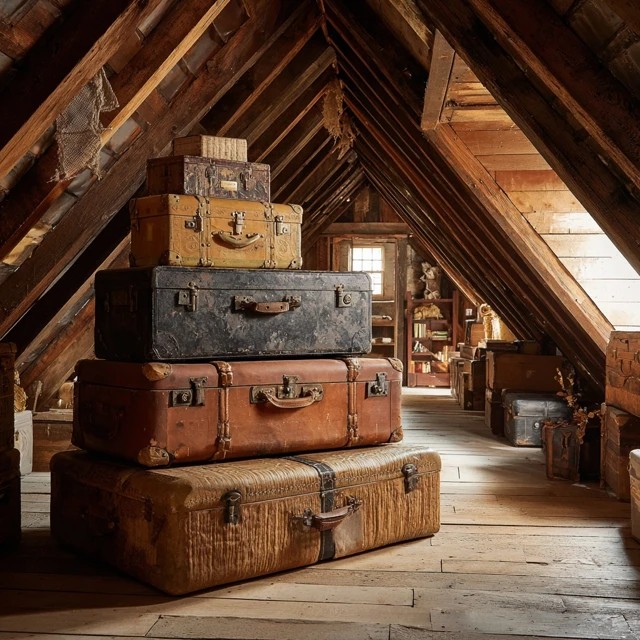
Vintage steamer trunks and antique suitcases stacked in the attic bring genuine storage capacity and unique visual character to a space that standard plastic bins cannot achieve — the aged leather, worn clasps, and faded labels create an atmosphere of history and accumulated living that makes the attic feel like a genuine family archive rather than a municipal storage facility.
- Line trunk interiors with acid-free tissue paper to prevent the wood and metal surfaces from transferring degrading compounds to stored items.
- Label each trunk clearly on the exterior with its current contents for practical daily storage rather than decorative purposes.
- Source genuine vintage trunks from estate sales and antique markets rather than reproduction pieces for authentic character and construction quality.
20. Uniform Container Sizes for Stackable Efficiency
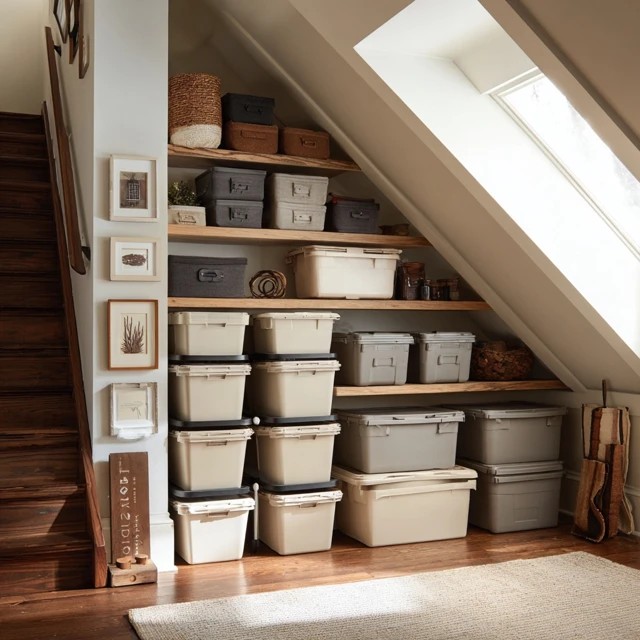
Committing to a single bin size and brand throughout the attic organisation system — or at most two complementary sizes that stack compatibly — creates the most space-efficient and structurally stable storage arrangement available.
- Select a bin size that accommodates your most commonly stored category — typically 60 litre for general household storage.
- Choose a bin with a robust interlocking lid that prevents the column from becoming unstable when upper bins are removed and replaced.
- Limit columns to no more than four bins high regardless of ceiling height — stability decreases significantly with each additional stacked level.
Why These Attic Organisation Ideas Excel
Every idea on this list succeeds because it addresses the fundamental requirements of usable attic storage: accessibility, identification, preservation, and safety.
Identification and categorisation — labeled bins, colour-coded containers, zone-based layouts, holiday boxes, and posted inventory lists — is what makes attic storage genuinely retrievable rather than simply stored. Items that cannot be found quickly in an attic cease to be stored items and become lost items, which is functionally equivalent to having thrown them away. Every investment in labelling, colour-coding, and inventory tracking pays dividends in every future retrieval.
Infrastructure and accessibility — pull-down stairs, rolling carts, clear pathways, and pegboard systems — is what determines whether the attic organisation system continues to be used and maintained over years. The most beautifully organised attic that is difficult to enter, navigate, and exit safely will revert to chaos within two or three seasonal cycles as household members avoid the effort and inconvenience of proper retrieval and return.
Conclusion
A well-organised attic transforms a household’s relationship with its own possessions — making seasonal transitions effortless, keepsake retrieval immediate, and the general sense of domestic order significantly more sustainable. Begin with safe access and clear pathways, establish zone boundaries and a consistent bin system, implement climate control for preservation, and maintain the inventory list as the system’s operational backbone.

Andrew is the founder and lead writer at RoomBlossom, a home decor publication dedicated to practical, intentional interior design. With over 10 years of hands-on experience transforming real-world living spaces — from compact apartments to full attic conversions — Andrew specialises in room design that balances visual appeal with everyday function. His work spans living rooms, bedrooms, sunrooms, and attic spaces, always guided by the belief that great design should work for the people who live in it, not just look good in photographs.