
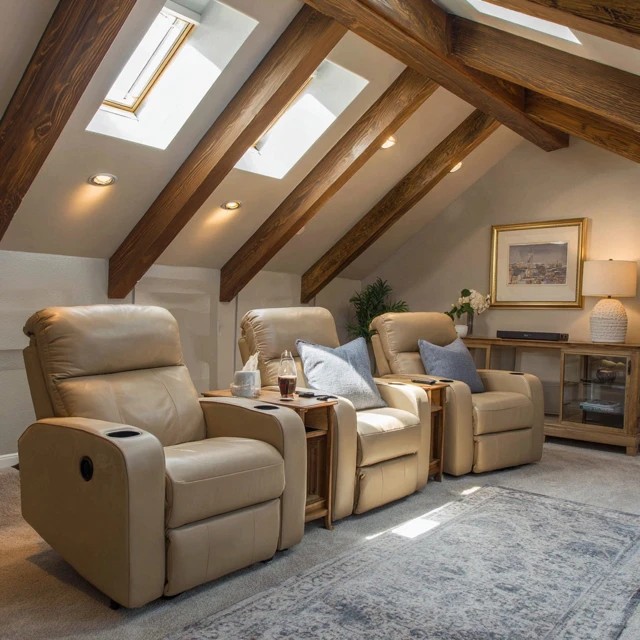
An attic TV room is one of the most practical uses of a converted attic — a dedicated viewing space where television can be watched at volume and the whole family can settle in for a film without competing with other household activities.
Here are 20 attic TV room ideas spanning screen setups, seating, audio, light control, and finishing details — each demonstrating how to create a viewing space that is comfortable, functional, and atmospheric.
1. Large Wall-Mounted TV as the Media Focal Point
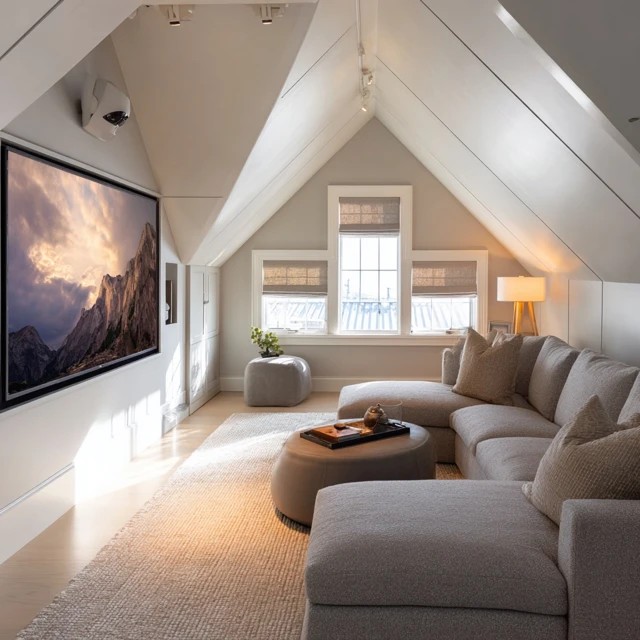
A large wall-mounted television positioned on the wall where ceiling height is greatest creates an immediately clear focal point that organises the entire attic TV room around it — seating, lighting, and supplementary equipment all oriented to maximise the viewing experience from the primary screen.
- Mount the TV so the screen centre sits at seated eye level — approximately 110cm from the floor — for comfortable sustained viewing.
- Use a full-motion wall mount so the screen angle can be adjusted for different seating positions across the room.
- Install blackout roller blinds on all windows before purchasing the screen — ambient light is the primary enemy of image quality.
2. L-Shaped Sectional Sofa for Optimal Viewing Seating
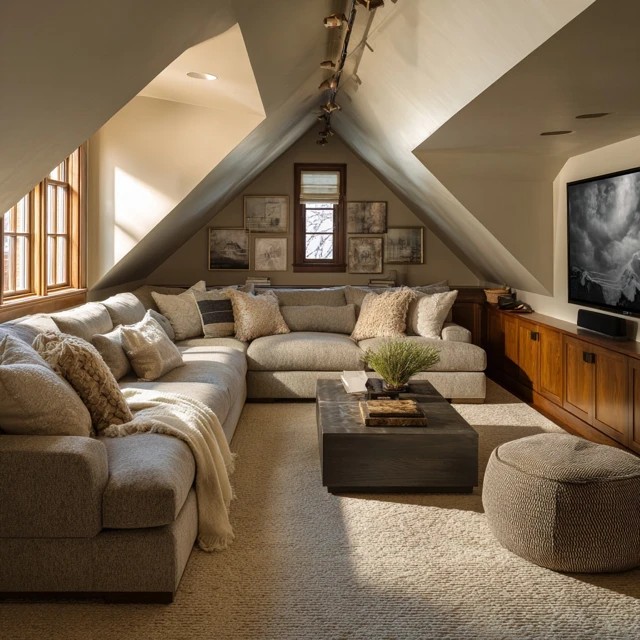
An L-shaped sectional sofa provides the most generous and socially inclusive seating for an attic TV room — accommodating multiple viewers at consistently good screen angles without any seat being the obvious “bad seat” that smaller sofa configurations inevitably create.
- Position the sectional so the longest side faces the screen directly and the chaise extension faces at no more than a 45-degree angle.
- Choose a performance fabric — stain-resistant and durable — for a TV room sofa that will withstand popcorn, drinks, and years of regular use.
- Allow at least 250cm between the sofa and the screen for the viewing distance appropriate to a 65-inch or larger television.
3. Media Console for Equipment Organisation
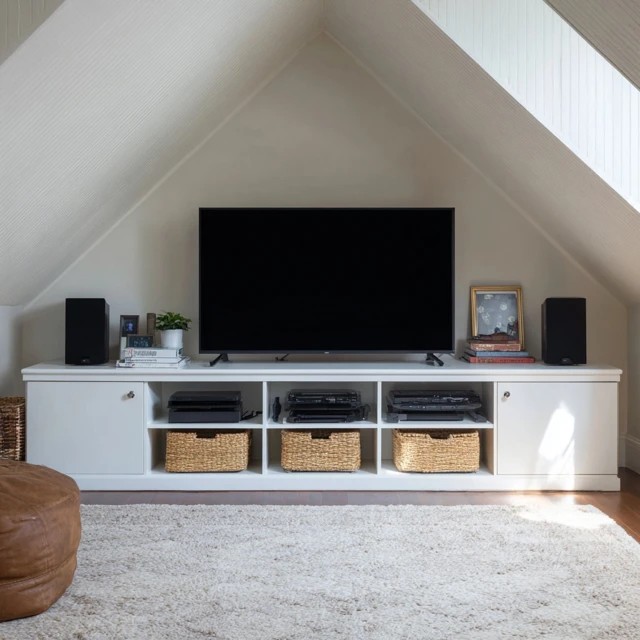
A low media console beneath the mounted television provides the most essential storage solution in any attic TV room — a home for gaming consoles, streaming devices, DVD players, receivers, and the accumulated accessories that a functioning home entertainment setup requires.
- Choose a console with ventilated cabinet sections — electronics generate heat and require air circulation to function reliably over time.
- Size the console to the full width of the television mount above it for a proportionally balanced entertainment wall composition.
- Use cable management channels through the console’s back panel to route all device cables neatly to a central power strip within.
4. Surround Sound System for Cinematic Audio
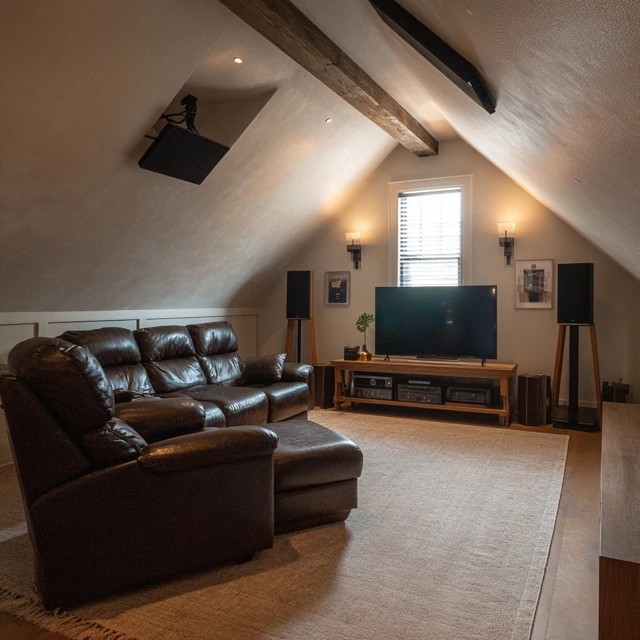
A properly configured surround sound system — front left, centre, and right speakers mounted at ear height, rear surrounds positioned behind the seating area, and a subwoofer placed near the front wall — transforms the attic TV room from a television room into a genuine home cinema.
- Mount front speakers at ear height when seated — approximately 100-110cm from the floor — for the most accurate sound stage.
- Position the subwoofer in a room corner near the front wall where bass frequencies are naturally reinforced by room boundaries.
- Run speaker cables through the wall during any renovation phase — surface-mounted cables are a permanent visual compromise.
5. Powered Reclining Chairs for Premium Viewing Comfort
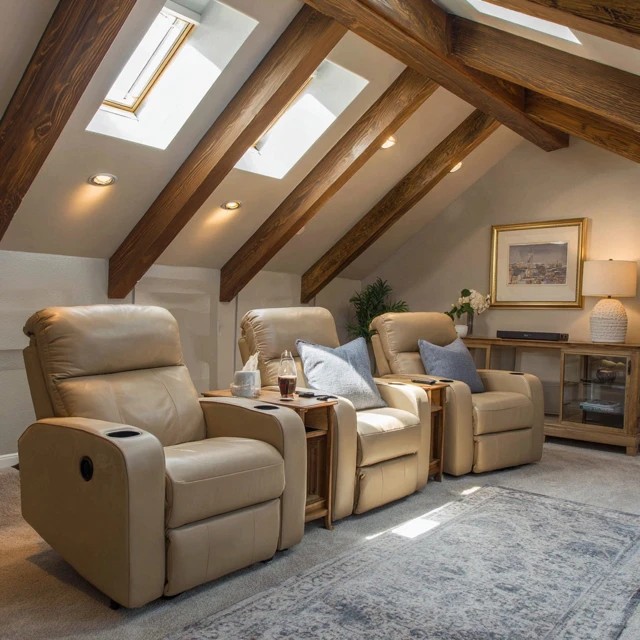
Powered reclining chairs — with electrically adjustable footrests, cup holders in each arm, and memory foam cushioning — deliver the closest residential equivalent to the premium cinema experience for those who prefer individual seating over a shared sofa. Two or three recliners positioned in a row facing the screen create a home theatre configuration with its own compelling intimacy, and
- Allow at least 45cm of clearance behind each recliner in its fully reclined position — most chairs need 30cm behind the mechanism.
- Choose recliners with USB charging ports in the arms for device charging without requiring additional sockets near the seating position.
- Select a leather or faux leather finish for recliners — fabric accumulates popcorn debris and is significantly harder to clean after spills.
6. Blackout Curtains or Shades for Perfect Light Control
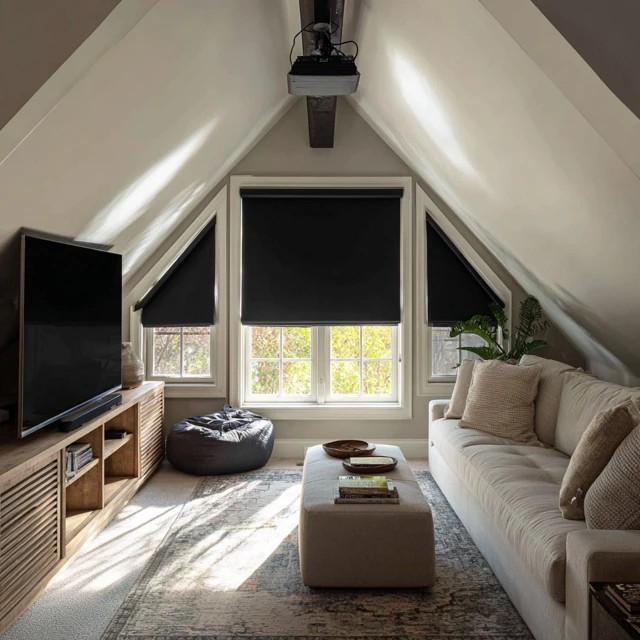
Complete blackout window treatments — motorised roller blinds or floor-length blackout curtain panels — are the most critically important investment in any attic TV room, since no screen technology compensates for ambient light washing out the image during daytime or evening viewing.
- Choose motorised blackout rollers with side guide channels that prevent light leakage at the edges of the blind.
- Test each window with a blackout sample before ordering — attic windows often have unusual frame dimensions that require custom-sized treatments.
- Connect motorised shades to a scene controller that drops the blackouts simultaneously with dimming the room lights when viewing begins.
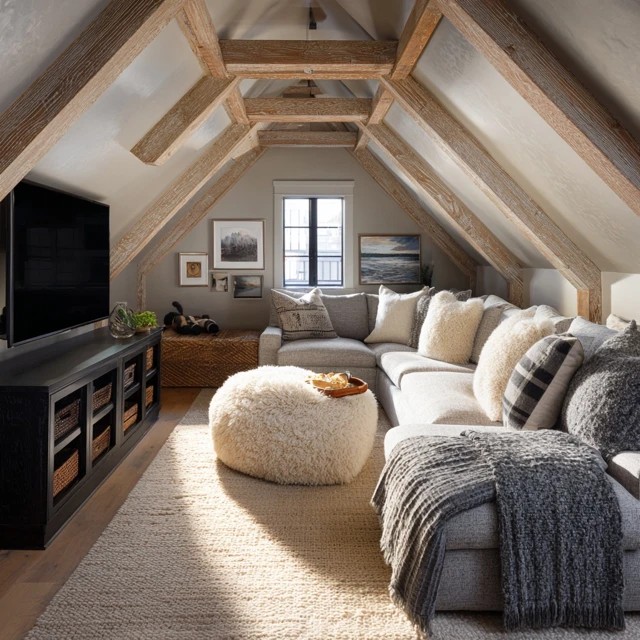
7. Exposed Wood Beams for Rustic Cinematic Atmosphere
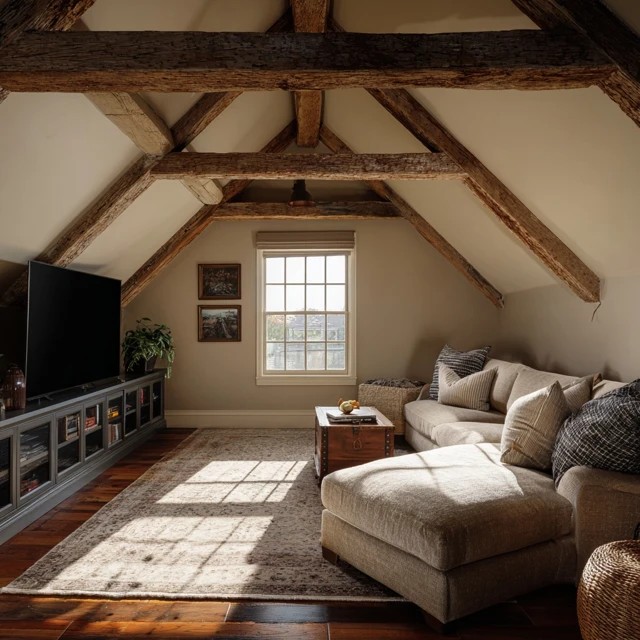
Exposed structural beams in the attic TV room ceiling add the atmospheric quality that distinguishes a genuinely characterful viewing space from a generic media room — the dark timber overhead, contrasting with the glow of the screen below, creates a cinematic intimacy that flat, plastered ceilings cannot achieve.
- Mount surround sound speakers directly to the beam structure using beam-rated fixing brackets for secure, architectural integration.
- Drape warm string lights along the beam lines for atmospheric evening illumination without ceiling-level fixture installation.
- Position the television on the wall between beam spans rather than directly behind a beam to prevent overhead obstruction of the screen.
8. Area Rug for Acoustic Softening and Zone Definition
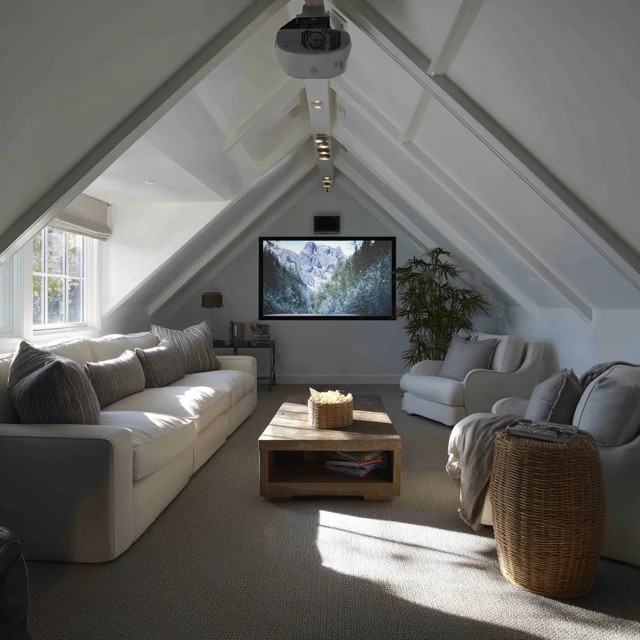
A large area rug placed beneath the sofa and extending to the viewing space’s boundaries provides two practical benefits beyond aesthetics: it acoustically softens the hard floor and sloped ceiling surfaces that create reverberant sound in an attic TV room, and it visually defines the dedicated viewing zone as a distinct, intentionally designed space within the larger attic area.
- Choose a rug large enough for the sofa’s front legs and the coffee table to sit fully within its boundary.
- Select a dense, medium-pile rug specifically for its acoustic absorption properties — flatweave rugs provide little sound-damping benefit.
- Use a non-slip rug pad beneath to prevent the rug from sliding when viewers shift and adjust their seating position during films.
9. Built-In Shelving for Media and Collection Storage
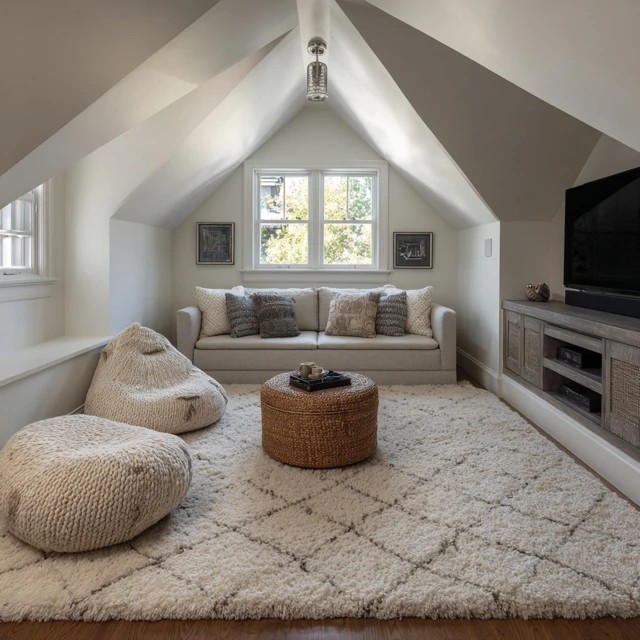
Built-in shelving on the solid wall sections of the attic TV room provides organised storage for DVDs, games, books, and the accumulated collectibles that fans of cinema and gaming naturally accumulate around their dedicated viewing spaces. The built-in format integrates the storage into the room’s architecture rather than placing freestanding units that consume circulation space, and
- Install adjustable shelves in the media storage section so varying DVD, Blu-ray, and game case heights can all be accommodated.
- Include one closed cabinet section within the built-in shelving for storing items that do not benefit from open display.
- Position the most visually interesting collectibles and display items at the most visible shelf sections — eye level from the sofa position.
10. Mini Fridge and Snack Bar for Movie Night Self-Sufficiency
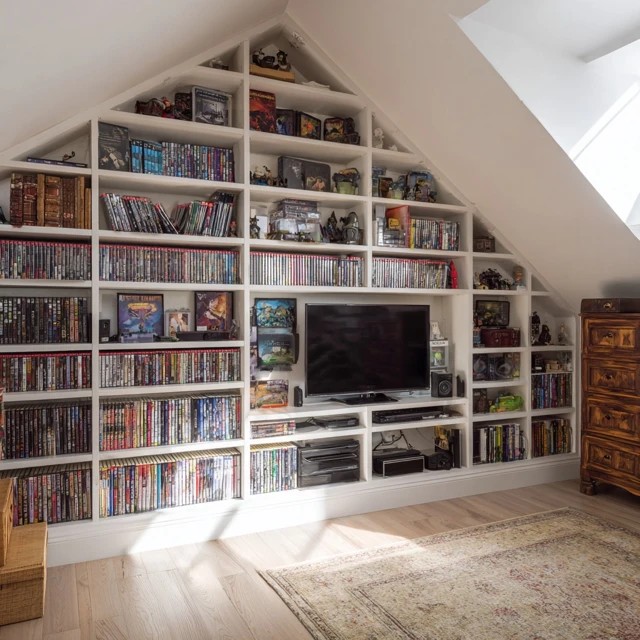
A compact refreshment station — a mini fridge beneath a short counter, with snack storage above and glassware on a wall-mounted shelf — makes the attic TV room genuinely self-sufficient for movie night without the need to pause the film for kitchen trips.
- Install the mini fridge beneath a 90cm counter-height surface so it doubles as a preparation surface for drinks and snacks.
- Add a small wine rack or drinks organiser above the counter for additional refreshment storage without consuming counter space.
- Connect the mini fridge to a dedicated circuit — it runs continuously and should not share a circuit with amplifiers or other sensitive electronics.
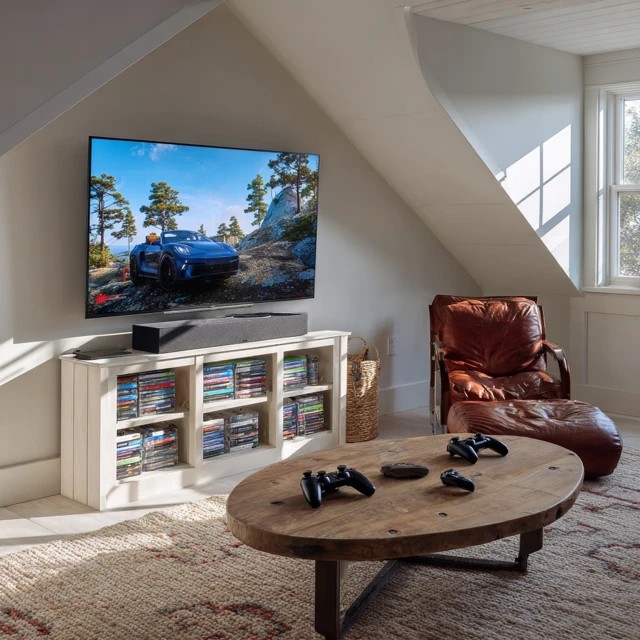
11. Gaming Console Setup for Interactive Entertainment
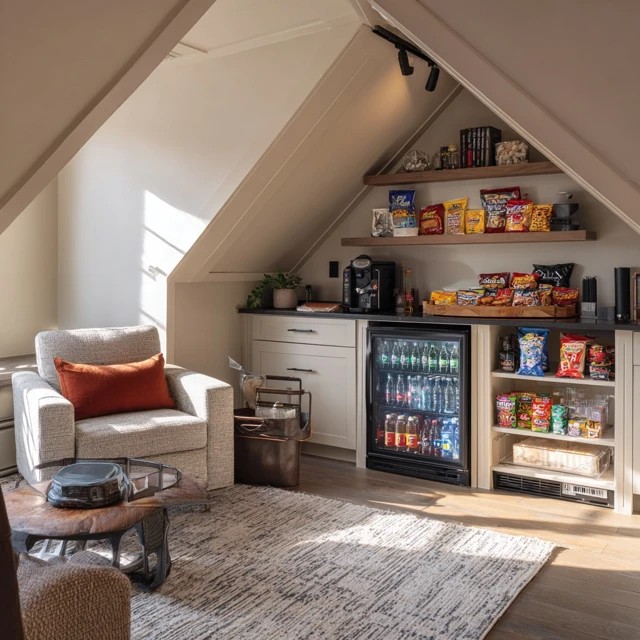
A gaming console integrated into the attic TV room’s media console — with controllers stored on a wall-mounted rack beside the console and games organised on adjacent shelving — transforms the viewing space into a multi-use entertainment room that serves gaming sessions as effectively as movie nights.
- Install a controller charging dock on the media console surface for organised, ready-to-use controller storage between sessions.
- Choose a console that also functions as a streaming device to reduce the total number of devices connected to the television.
- Add an HDMI switch if multiple consoles or devices are connected — it simplifies input selection without requiring device swapping.
12. Ceiling-Mounted Projector for Large-Screen Cinema Experience
A ceiling-mounted projector projecting onto a motorised pull-down screen — or a painted projection wall — delivers a screen size that no residential television can match, creating a genuinely cinematic viewing experience in the attic TV room’s dedicated dark environment.
- Choose a projector with at least 2000 ANSI lumens for acceptable image brightness even when blackout blinds are not perfectly sealed.
- Mount the screen at a height so the bottom edge is at seated eye level when fully deployed — typically 90-100cm from the floor.
- Use an acoustic transparent screen if placing front speakers behind the screen for the most coherent audio and visual alignment.
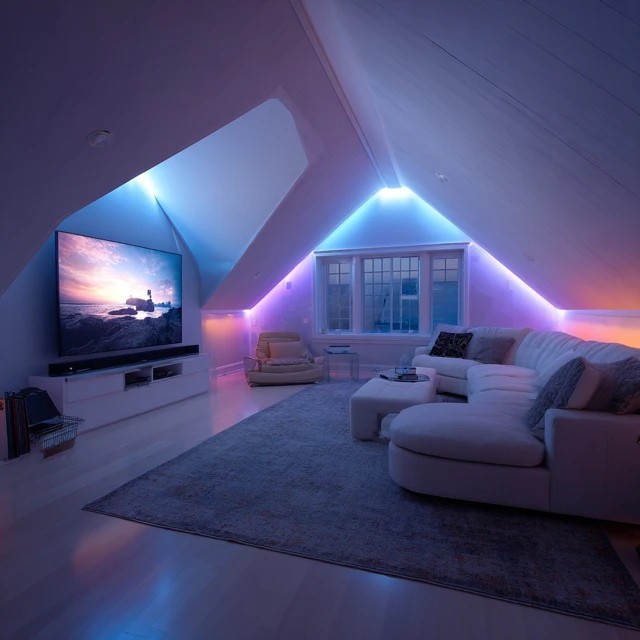
13. Ambient LED Lighting for Mood Atmosphere
LED strip lights mounted behind the television — providing a bias lighting effect that reduces eye strain contrast between the bright screen and the dark room — combined with colour-changing LED strips along the room’s edges, create a completely controllable atmospheric lighting system for the attic TV room.
- Set the TV bias lighting to a colour temperature matching the screen’s white point — approximately 6500K — for the most effective strain reduction.
- Choose LED strips with a 5050 SMD chipset for the most saturated colour output from the decorative room edge strips.
- Connect all LED circuits to a smart home controller so the entire lighting scene can be adjusted from the sofa with a single command.
14. Bean Bag Chairs for Casual Flexible Seating
Large bean bags provide the attic TV room with seating that children and teenagers gravitate to naturally — low to the floor, completely posture-adjustable, and instantly moveable for different viewing positions or to clear the floor for active game play.
- Choose XL-sized bean bags with a 300-litre fill minimum for adult viewing comfort over extended film sessions.
- Select bean bags with removable, machine-washable covers for practical maintenance in a snack-and-drink environment.
- Store deflated spare bean bags in a wall cabinet for immediate deployment when larger groups require additional seating.
15. Cable Management System for a Clean Professional Setup
A complete cable management system — cables routed through the wall between the television mount and the media console below, with surface-mounted cable channels for any runs that cannot be concealed in the wall, and a centralised power management strip hidden within the media console — creates the clean, professional appearance that makes the difference between a DIY television installation and a finished media room.
- Route all cables between the TV mount and the console through an in-wall cable management kit for the cleanest possible installation.
- Use a cable raceway in the same colour as the wall for any surface runs that cannot be concealed within the wall structure.
- Label every cable at both ends during installation so any future reconfiguration does not require tracing cable routes from scratch.
16. Acoustic Panels for Sound Isolation and Quality
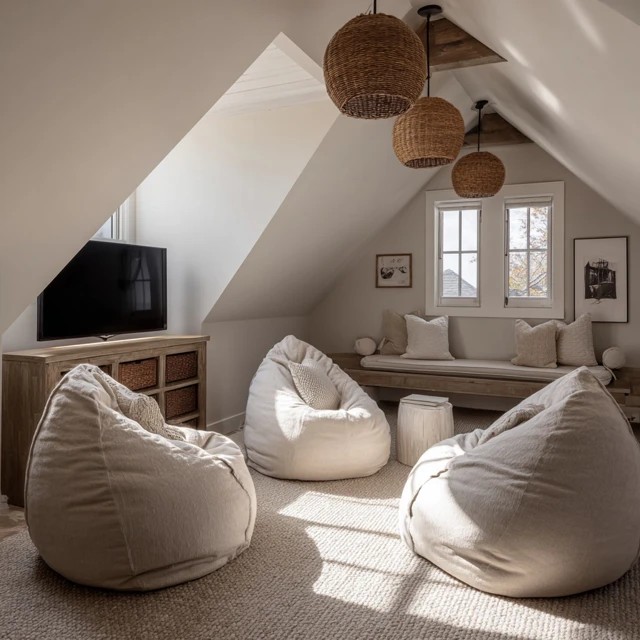
Fabric-wrapped acoustic panels on the attic TV room’s walls serve two distinct functions: they prevent sound from transmitting through the floor to the rooms below, and they improve the audio quality within the room itself by absorbing the reflected sound waves that make a hard-surfaced room sound reverberant and unclear.
- Cover at least 25% of the room’s wall area with acoustic panels for meaningful noise reduction and audio quality improvement.
- Position acoustic panels at first reflection points — the wall sections directly beside the listening position at ear height.
- Choose panels with an NRC rating of 0.85 or higher for the most effective broadband sound absorption across the audio frequency range.
17. Window Seat with Storage for Flexible Seating
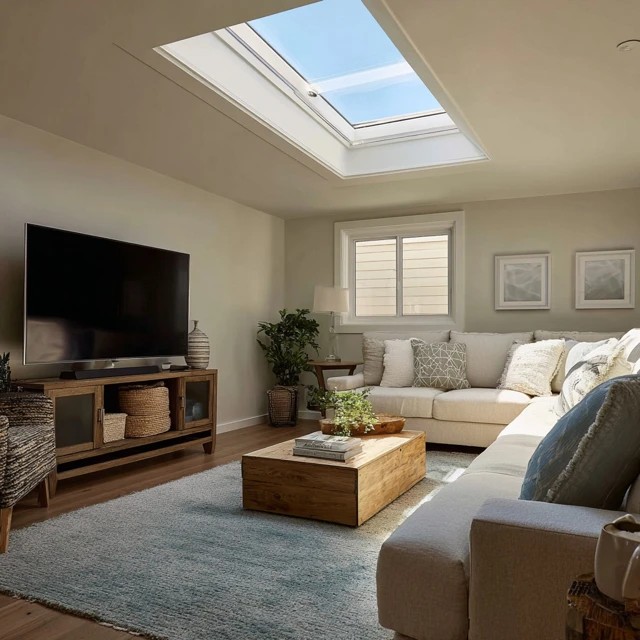
A built-in window seat in the dormer alcove — with blackout blinds above for film viewing and storage drawers beneath for blankets and media accessories — adds supplementary seating for the attic TV room that requires no additional floor space.
- Upholster the window seat cushion in a washable performance fabric — it will receive significant use as overflow seating during busy film nights.
- Install the window seat blackout blind before the cushion is fitted for the cleanest mechanical integration between seat and window treatment.
- Use the storage beneath the window seat for blankets, spare cushions, and the media accessories that the room accumulates over time.
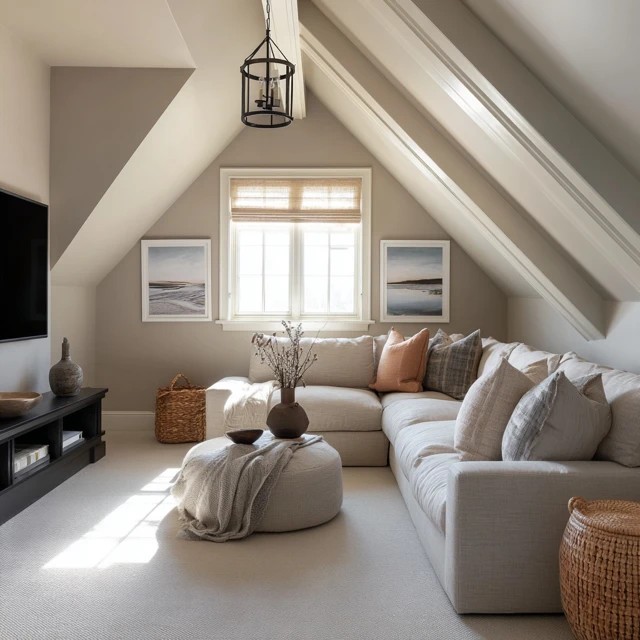
18. Neutral Colour Palette for a Serene Viewing Environment
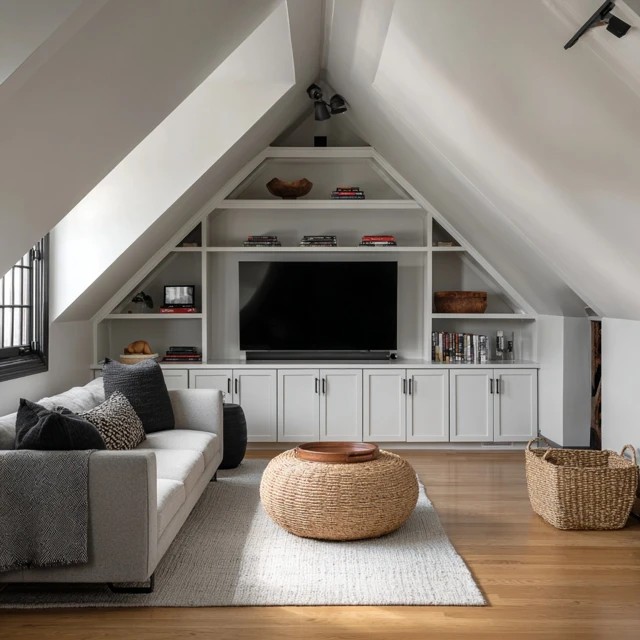
A palette of warm greys, soft beiges, and muted whites creates the most restful and visually non-competing backdrop for a dedicated viewing space — the neutral walls and ceiling allow the screen to remain the room’s undisputed visual focus, and the absence of bold colour or pattern prevents the visual stimulation that competes with the viewed content during films and television.
- Paint the wall directly behind the television in the darkest available neutral tone to create a visual anchor for the screen.
- Use the same neutral on the sloped ceiling surfaces as on the walls for the most seamless, enveloping neutral environment.
- Introduce warmth through a single warm-wood element — media console, window seat frame — rather than multiple competing warm accents.
19. Skylight with Blackout Shade for Flexible Illumination
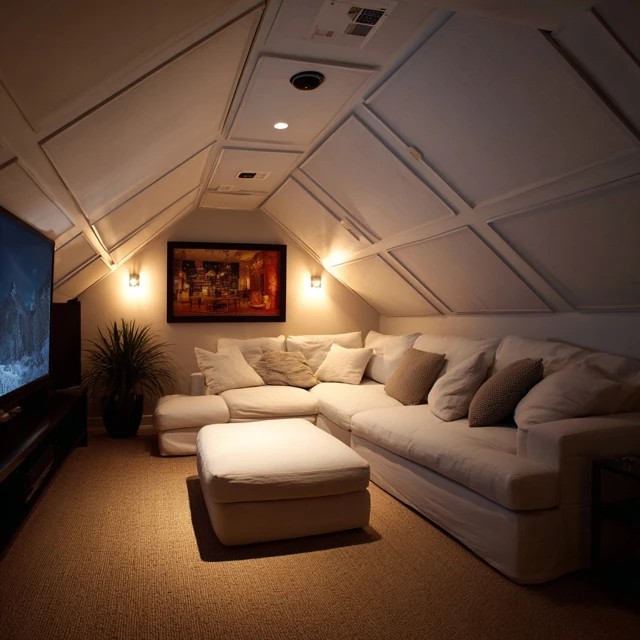
A skylight with an integral motorised blackout blind serves the attic TV room’s dual needs perfectly — abundant natural overhead light for daytime activities, complete darkness for film viewing at any hour.
- Choose a roof window unit with an integral blackout blind rather than a separately fitted blind for the most reliable light exclusion.
- Install the skylight over the seating rather than over the screen to illuminate viewers with natural light between viewings.
- Connect the skylight blackout blind to the same scene controller as the wall window treatments for simultaneous blackout operation.
20. Throws and Cushions for Layered Comfort and Invitation
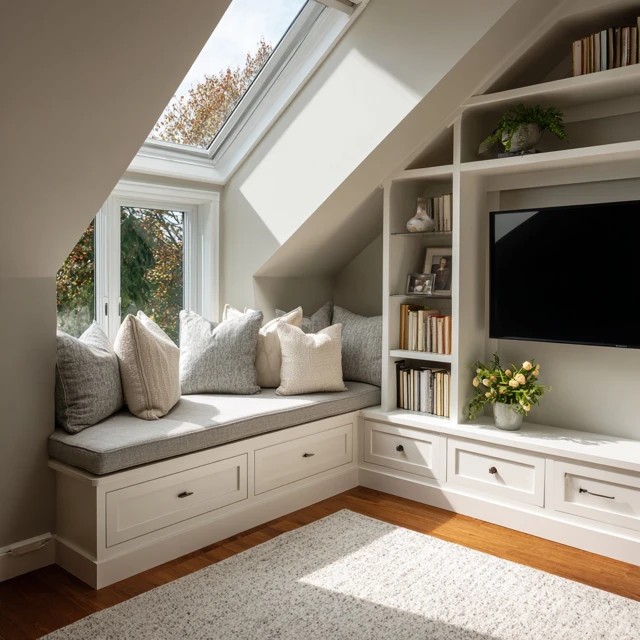
Throw blankets and cushions layered generously across the sofa and bean bags create the attic TV room’s most immediately sensed quality — the tactile invitation to settle in for a long viewing session without reservations about comfort.
- Store throws in a large woven basket beside the sofa for immediate access without disrupting the sofa’s styled appearance between uses.
- Choose throws in complementary tones to the sofa colour rather than exact matches for the most visually layered textile quality.
- Rotate cushion covers seasonally — lighter cottons and linens in summer, heavier knits and velvets in autumn and winter.
Why These Attic TV Room Ideas Excel
Every idea on this list serves the fundamental purpose of a dedicated TV room: creating an environment where viewing is more comfortable and.
Comfort infrastructure — the sectional, recliners, bean bags, throws, and rugs — determines how long viewers actually stay. A technically excellent cinema with uncomfortable seating gets abandoned; a warm, comfortable room becomes the household’s favourite.
Practical performance — blackout treatments, surround sound, cable management, and acoustic panels — is what separates a genuine media room from a room that simply contains a television.
Conclusion
An attic TV room gives the household something genuinely valuable — a dedicated viewing space that does not compete with other rooms’ functions and can be fully optimised for the single purpose of watching and listening in comfort. Begin with blackout treatments and the screen, build seating around optimal viewing distance, invest in audio, and layer in the comfort details that make the room genuinely special.

Andrew is the founder and lead writer at RoomBlossom, a home decor publication dedicated to practical, intentional interior design. With over 10 years of hands-on experience transforming real-world living spaces — from compact apartments to full attic conversions — Andrew specialises in room design that balances visual appeal with everyday function. His work spans living rooms, bedrooms, sunrooms, and attic spaces, always guided by the belief that great design should work for the people who live in it, not just look good in photographs.