

An attic closet transforms one of the home’s most architecturally challenging spaces into one of its most personally useful — a dedicated dressing area where sloped ceilings, eave depths, and angled walls become custom storage solutions rather than obstacles. With the right built-in system, an attic can house a full wardrobe, shoe collection, jewellery organiser, and seasonal rotation system in a space that would otherwise go to waste.
Here are 20 attic closet ideas spanning built-in wardrobes, sloped shelving, cedar lining, LED lighting, and organisational systems — each one demonstrating how to convert a converted attic’s unique geometry into a beautifully functional personal dressing space.
1. Built-In Wardrobe System Along the Knee Walls
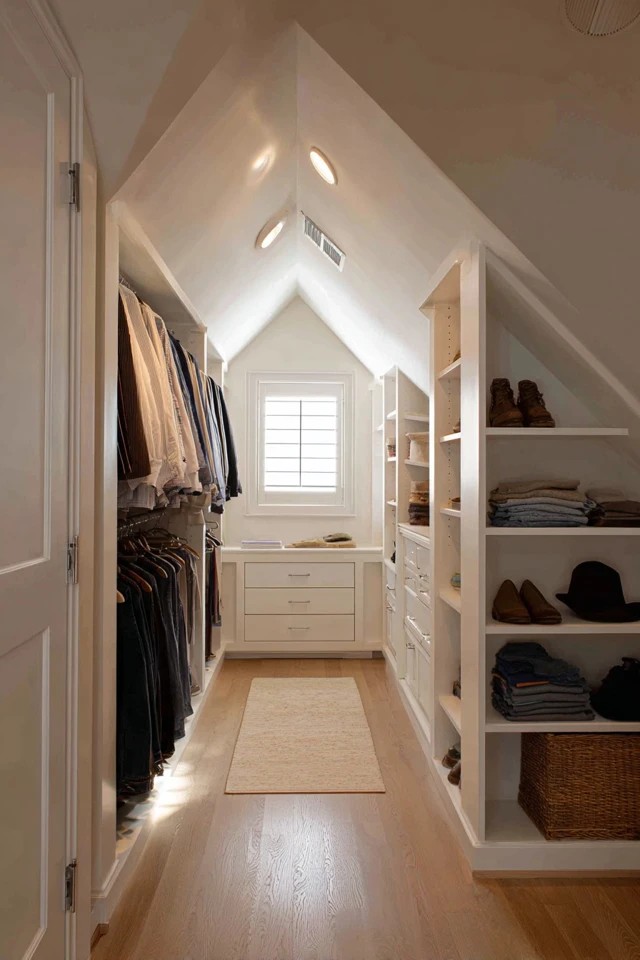
Built-in wardrobe units running along the knee walls — the short vertical sections where the floor meets the beginning of the roof slope — create the most efficient possible use of the attic closet’s available storage geometry. Floor-to-ceiling hanging rods and shelves fitted precisely to the knee wall height maximise every usable centimetre, and double-hanging rod configurations in the shorter sections double the clothing capacity where ceiling height limits to half-length garments.
- Use double hanging rods in sections where ceiling height allows — one at 80 inches and one at 42 inches for folded garments.
- Commission a joiner to build the units to the exact knee wall height for a fully integrated, architectural appearance.
- Paint built-in wardrobe units the same colour as the surrounding walls for the most seamless visual integration.
2. Angled Shelving Following the Roofline

Shelves built to follow the angle of the roof slope rather than running horizontally create a storage system that harmonises with the attic’s geometry rather than fighting it.
- Build angled shelves with a slight lip at the front edge to prevent items from sliding forward on the inclined surface.
- Finish angled shelves in the same material as the knee wall cabinetry for a cohesive, unified closet composition.
- Label each shelf level clearly so the organisation system remains logical when the closet is accessed quickly during morning routines.
3. Full-Length Mirror on the Closet Door for Outfit Viewing

A full-length mirror mounted on the closet door provides the essential outfit-viewing function while consuming no floor space and no additional wall area beyond the door itself.
- Use a frameless or minimal-frame mirror on the door for the lightest possible mirror-to-door relationship.
- Choose a mirror adhesive and backing plate rated for door vibration — standard wall mounting methods fail on frequently moved surfaces.
- Position the door so the mirror faces the most naturally lit section of the closet space for the best outfit viewing light.
4. Cedar-Lined Walls for Natural Moth Protection
Aromatic cedar planks lining the walls, ceiling, and back panel of the attic closet create a naturally moth-resistant environment for wool, cashmere, and delicate textile garments vulnerable to insect damage.
- Sand the cedar surface lightly with 120-grit paper every two to three years to refresh the aromatic oils as the surface weathers.
- Seal all gaps and joints in the cedar closet thoroughly to prevent moths from entering through any small openings.
- Ensure garments are clean before storing — food and perspiration residues are the primary moth attractant, not the fabric itself.
5. Pull-Out Drawers Under the Eaves for Accessible Folded Storage

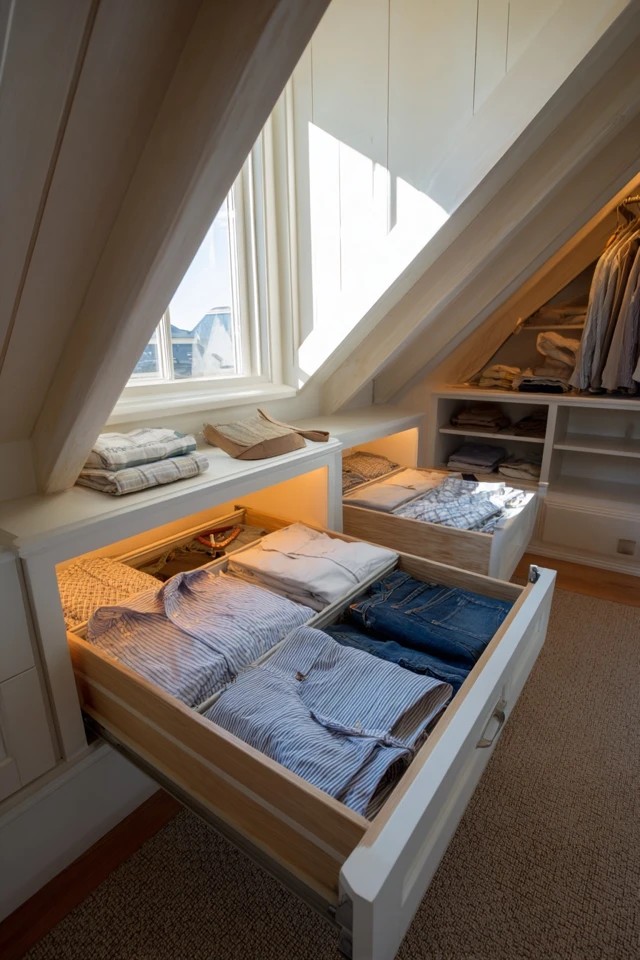
Pull-out drawers built into the lowest eave sections — where ceiling height drops below practical standing level — use the attic closet’s most awkward geometric zones for one of its most essential storage functions.
- Use full-extension ball-bearing drawer slides so every inch of drawer depth is accessible without bending or stretching.
- Build drawer heights of 4-6 inches for folded T-shirts and underwear, 8-10 inches for folded jumpers and jeans.
- Label each drawer on the front exterior so the contents are identifiable without opening every drawer during a morning search.
6. Shoe Storage Racks for Organised Footwear Display

Angled shoe shelves or open cubbies mounted on the vertical knee wall sections display the shoe collection visibly and accessibly, making selection fast and returning pairs easy.
- Set shoe shelf spacing at 7-8 inches for flat shoes and trainers, 12 inches for boots and heels.
- Use angled shelves rather than flat ones — the tilt displays the shoe’s style while keeping pairs naturally together.
- Add a clear-front shoe box option on the upper shelves for out-of-season shoes that need protection without losing visibility.
7. Skylight for Natural Daylight Dressing Illumination

A skylight set into the attic closet’s sloped ceiling provides the most valuable possible illumination for a dressing space — natural daylight that renders fabric colours accurately and eliminates the colour-shifting effect of artificial lighting that causes many poor outfit choices.
- Position the skylight centrally so natural light reaches both sides of the closet’s hanging and shelving zones equally.
- Choose a diffusing glass type to eliminate direct sun patches on hanging garments that could cause localised fading.
- Add a motorised blind to the skylight for privacy and to prevent morning sun from creating contrast that makes colour assessment difficult.
8. White Painted Shelving for Light-Reflective Brightness

White-painted wood shelving throughout the attic closet maximises the reflection of both natural and artificial light, creating a bright, clearly visible storage environment where every folded garment and stored item is easy to locate.
- Use a semi-gloss finish on shelving rather than flat paint for easier cleaning and improved light reflectance.
- Apply two coats of primer before painting shelving for a durable finish that resists the scuffing that clothing storage creates.
- Match the white of the shelving to the wall paint precisely for the most seamlessly integrated closet appearance.
9. Hanging Rods at Varied Heights for Garment-Appropriate Storage

Installing hanging rods at different heights to match the garments hung on each — full-length dresses and coats at the greatest available height, shorter jackets and shirts at a medium height, folded trousers at the lowest position — creates a closet organised by garment type that uses ceiling height variation intelligently across different sections.
- Allow at least 64 inches of clear hanging height for full-length dresses and coats from the highest rod position.
- Set the short-hanging rod at 40-42 inches so folded trousers hang without touching the drawers or shelves below.
- Group garment categories consistently — all shirts together, all trousers together — so each rod’s zone is logically assigned.
10. Jewellery Organiser Drawer for Accessory Care

A velvet-lined drawer with individual compartments for rings, earrings, necklaces, and watches keeps the jewellery collection tangle-free, visible at a glance, and protected from the scratching that loose storage in a box creates.
- Choose a velvet liner in a contrasting colour to the jewellery metal tones — grey velvet for gold, navy for silver — for visibility.
- Include at least three different compartment sizes in the organiser to accommodate rings, bangles, and necklaces with equal ease.
- Position the jewellery drawer at a height accessible when standing — 34-38 inches from the floor — for comfortable daily use.
11. Belt and Tie Rack for Specialist Accessory Organisation

Dedicated hooks or a pull-out rack for belts and ties keeps these accessories visible, wrinkle-free, and quickly accessible — a significant daily convenience compared to fishing through a drawer for the right belt or untangling ties from a shared hook.
- Install a pull-out tie rack with individual metal hooks spaced 2 inches apart for 20-30 ties without crowding.
- Add a separate belt bar — a horizontal chrome rod — at a convenient height for hanging rolled or flat-stored belts by their buckle.
- Position the accessory rack adjacent to the shirt hanging section for a logical, efficient morning dressing workflow.
12. Built-In Laundry Hamper for Concealed Dirty Clothes Storage

A pull-out laundry hamper built into the base of the closet cabinetry conceals dirty clothes within the dressing space itself, eliminating the visual clutter of a freestanding hamper while keeping soiled garments in the most logical location — the place where they are removed.
- Build the hamper compartment with ventilation holes in the sides to prevent odour buildup from stored dirty clothing.
- Use a fabric liner bag inside the hamper frame for easy removal and direct transfer to the washing machine.
- Size the hamper to hold at least a full wash load — approximately 40-50 litres — to avoid constant emptying throughout the week.
13. LED Lighting Strips for Task-Quality Closet Illumination

LED strip lights mounted inside shelving units, along the front edges of shelf surfaces, and beneath hanging rails provide the even, shadow-free task illumination that makes a closet genuinely easy to use after dark and during the early morning hours when natural light is insufficient.
- Choose warm-white LED strips (2700-3000K) for the most accurate fabric colour rendering in the closet environment.
- Install strips along the underside of each shelf so light falls downward onto the shelf below — the most practical position for visibility.
- Connect all closet LED lighting to a single switch at the entry point for convenient one-touch operation on arrival.
14. Valet Hook or Chair for Outfit Staging
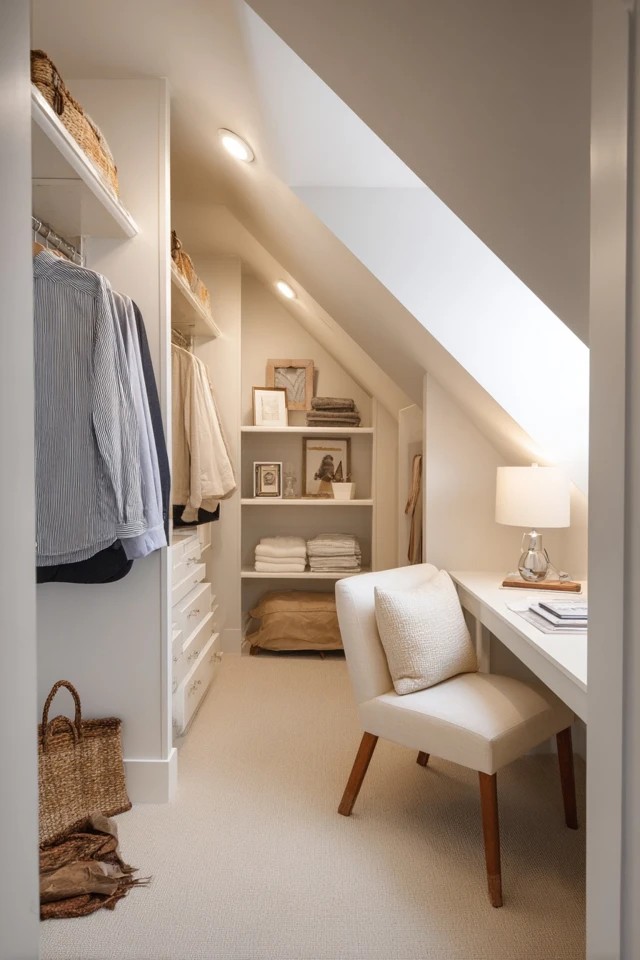
A mounted valet hook or a small fold-down bench provides a dedicated staging area for the next day’s outfit — the morning routine’s most valuable efficiency tool.
- Mount the valet hook at a height that accommodates a complete outfit — jacket on top, shirt beneath — without the items touching the floor.
- Position the valet hook directly opposite the full-length mirror for an immediate visual check of the staged outfit.
- Add a small tray or hook cluster beside the valet hook for accessories — watch, cufflinks, jewellery — associated with the staged outfit.
15. Seasonal Rotation System for Year-Round Wardrobe Management

A deliberate seasonal rotation system — current-season garments in the most accessible front positions, off-season garments stored in labelled bins or garment bags at the back or upper shelves — keeps the usable portion of the closet clear and navigable without relocating garments outside the attic closet entirely.
- Store off-season garments in breathable cotton garment bags rather than sealed plastic to prevent fabric deterioration.
- Label stored bins with the season and year so items can be located immediately when the rotation time arrives.
- Use the seasonal rotation as a wardrobe review — any item not worn in the past year is a candidate for donation or sale.
16. Pull-Down Closet Rod for High-Ceiling Access

A pull-down rod mechanism installed at the highest available hanging height in the attic closet uses the full ceiling dimension for storage while maintaining easy access — the rod lowers to a reachable height on a spring-loaded arm and returns to the upper position after loading or unloading.
- Choose a pull-down rod rated for the total weight of garments it will hold at its highest stored position.
- Install the mechanism in the section with the greatest ceiling height — typically the centre of the attic at the ridge line.
- Use the pull-down rail for lighter garments — blouses, shirts — rather than heavy coats that strain the spring mechanism over time.
17. Woven Baskets on Upper Shelves for Soft Goods Organisation

Woven or wire baskets on the upper shelves of the attic closet hold bulky soft goods — sweaters, scarves, hats, and folded accessories — in a flexible, pull-out format that is easier to use than individual folded items stacked directly on the shelf.
- Choose baskets with front labels rather than top labels — closet baskets are accessed from the front and below, not from above.
- Line baskets holding delicate items with acid-free tissue paper to prevent the basket material from snagging fabric.
- Use matching basket styles throughout the upper shelves for a cohesive, deliberately organised visual effect.
18. Full-Wall Shelving for Maximum Storage Capacity

A single wall covered entirely with floor-to-ceiling shelving provides the attic closet’s maximum possible open storage capacity — folded garments, boxes, baskets, accessories, and seasonal items all stored on a single wall system that uses every available square foot from skirting to ceiling.
- Install adjustable shelf pins on the full-wall system so shelf heights can be reconfigured as the wardrobe’s contents change over time.
- Allocate the lower two-thirds of the wall for frequently accessed items and the upper third for seasonal or rarely accessed storage.
- Use matching bins and folded garment containers on the open shelves for a visually organised rather than chaotic full-wall appearance.
19. Colour-Coded Clothing Organisation for Systematic Display

Organising hanging garments in colour sequence — from white through neutrals, pastels, and mid-tones to deep jewel tones and black — creates an attic closet that is simultaneously beautiful to look at and genuinely practical to use.
- Apply the colour system consistently — choose whether to sort warm or cool tones first and maintain that logic throughout.
- Re-sort garments after laundry days so the colour system remains accurate rather than gradually deteriorating into disorder.
- Combine colour-coding with garment-type grouping — all shirts in colour order, then all trousers in colour order — for maximum retrieval efficiency.
20. Ventilation Grate or Fan for Climate-Controlled Freshness

A ventilation grate connected to the home’s ventilation system or a small dedicated fan unit maintains fresh air circulation through the attic closet, preventing the mustiness that develops in any enclosed space where clothing — particularly natural fibres — is stored for extended periods.
- Install a ventilation grate near the floor level where cool air enters and another near the ceiling where warm, humid air can exit.
- Use a small silent bathroom extractor fan on a timer in closets without natural ventilation access for continuous air exchange.
- Keep the closet door slightly ajar when not in use to allow passive air circulation through the space throughout the day.
Why These Attic Closet Ideas Excel
Every idea on this list succeeds because it treats the attic closet’s geometry — the sloped ceilings, the varying heights, the eave depths, the angular walls — as the design brief for a custom storage system rather than a set of obstacles to work around.
Custom build quality is the investment that separates a well-functioning attic closet from a frustrating one. Standard wardrobe systems from furniture retailers are designed for flat-ceilinged rooms and adapt awkwardly to attic geometry at best.
Climate and preservation — cedar lining, ventilation, seasonal rotation systems, and proper garment storage — is what makes an attic closet a genuinely responsible home for a valuable wardrobe collection. The attic’s temperature and humidity variation is greater than any other room in the house, and the design ideas on this list address this challenge directly with solutions that protect stored garments from the environment that surrounds them.
Lighting quality — skylights for natural daylight, LED strips for evening illumination, white painted surfaces for light reflection — is often underestimated in closet design but is critically important for accurate outfit selection and enjoyable use of the dressing space. A dark, poorly lit closet is not only inconvenient but causes colour-matching errors that only become apparent in better light conditions outside.
Conclusion
An attic closet designed to embrace rather than fight its architectural geometry becomes one of the most functional and satisfying spaces in the entire house — a fully personalised wardrobe system that uses every sloped corner, every eave depth, and every angular wall to store, organise, and display a complete clothing collection. Invest in bespoke joinery, prioritise natural light from a skylight, line the walls with cedar, install LED task lighting throughout, and build an organisational system suited to your specific wardrobe habits.

Andrew is the founder and lead writer at RoomBlossom, a home decor publication dedicated to practical, intentional interior design. With over 10 years of hands-on experience transforming real-world living spaces — from compact apartments to full attic conversions — Andrew specialises in room design that balances visual appeal with everyday function. His work spans living rooms, bedrooms, sunrooms, and attic spaces, always guided by the belief that great design should work for the people who live in it, not just look good in photographs.